
A three-way hose splitter is worth considering when a tap must serve three distinct watering tasks and each branch needs its own shutoff. It may avoid leaving a fourth unused outlet on a four-way body, yet outlet count alone is not a reason to buy it. The tap supply, branch spacing, timer size, hose routing and valve access decide whether the three-way layout works. This guide uses Hengxin’s listed three-outlet model as a sourcing starting point while keeping unverified dimensions and performance claims open for supplier confirmation.
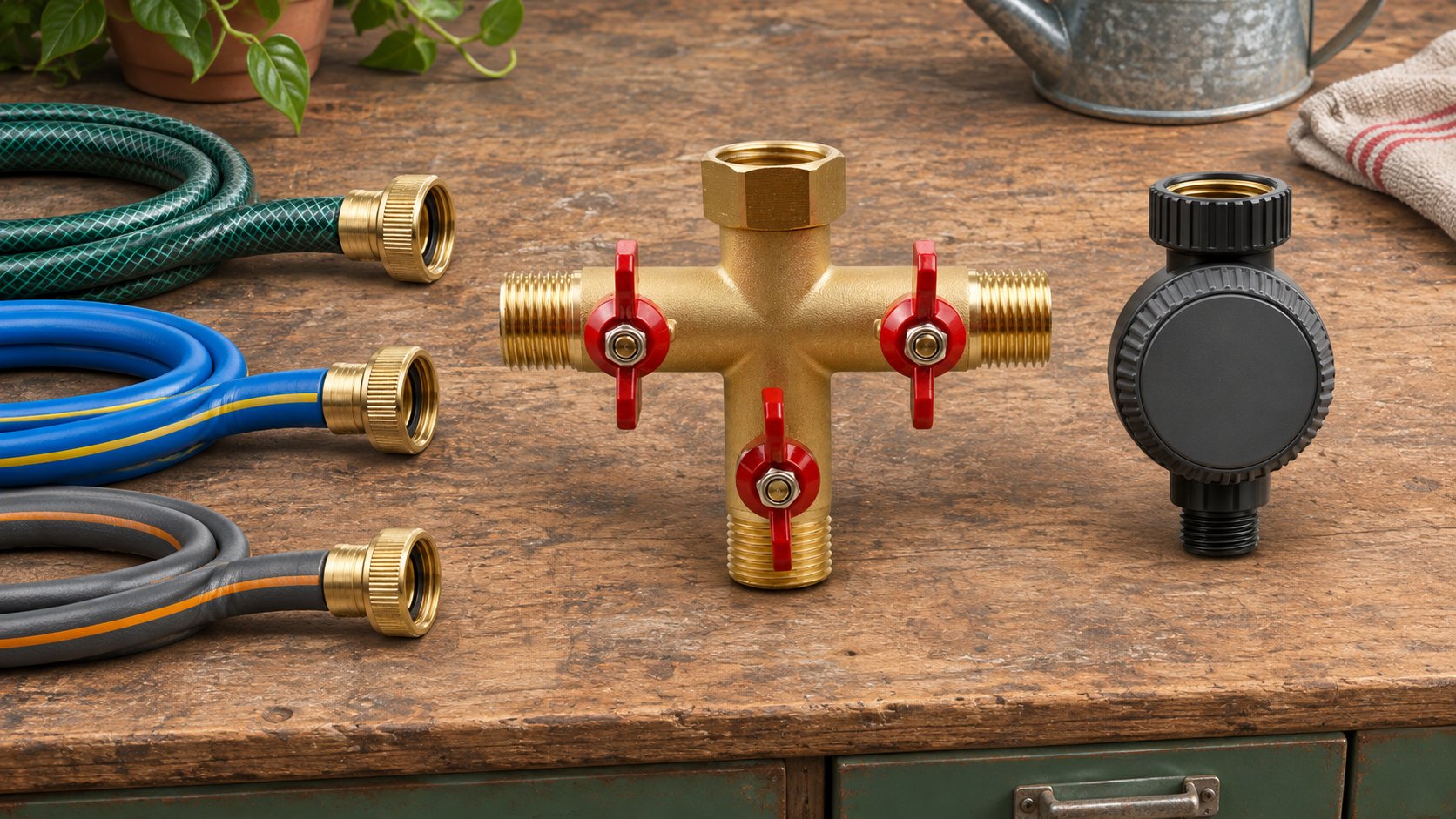
Start with three real branches
Draw the customer’s uses: perhaps a soaker hose for a vegetable bed, a timer-fed sprinkler and a hand hose. Identify which branches run at the same time, which need occasional access, and which accessories remain installed. A three-way body gives three connection points, but it does not increase the water available from the tap. If all three branches need significant flow together, test that exact configuration at the downstream equipment.
Make a branch table with the hose length and bore, connector, timer or filter, operating schedule and required inlet condition for each downstream device. This avoids treating three outlets as three identical loads. A short hand hose that runs only occasionally has different demands from a long irrigation line. If simultaneous use is rare, separate schedules may be a reasonable design choice; if it is essential, include it in the acceptance test.
| Branch | Typical question | What to record |
|---|---|---|
| Manual hose | Can the user reach its valve without moving other equipment? | Connector size, hose route and access |
| Timed irrigation | Does the timer fit and remain serviceable? | Housing envelope, battery access and orientation |
| Soaker or drip line | Does it have the required downstream controls? | Filter, pressure-control and backflow review |
Independent control must remain usable
Many three-way splitters are sold with a separate valve for each branch. Check the exact model rather than assuming every three-outlet body has three independent shutoffs. On a sample, turn each valve while the other two branches remain installed. Observe whether the handle clears neighboring connectors, the wall and the tap handle. A valve that cannot be reached once two timers are fitted does not provide useful independent control in that kit.
Test the open and closed state of each branch under a defined water condition. Do not infer a leak-free shutoff from a product photo or from the number of handles. Record which outlet, valve position and first wet point if a leak appears. If the buyer needs a cycle-life statement, request a model-specific method and results rather than transferring a claim from a two-way or four-way version.
Compare two, three and four outlets by layout
A two-way model may be enough when one branch can be changed manually or when only two outlets are needed at any one time. A four-way model may be appropriate when the fourth permanent branch will be used and the tap has enough space for the wider body. A three-way model can be a good middle configuration when three branches stay connected. The tradeoff is physical layout: a third outlet may crowd a timer even if a four-way model from another design has wider spacing.
Compare actual drawings and samples. Measure overall body width, inlet position, outlet center spacing and valve-handle sweep. Check whether the branches are straight, angled or rotating. A broad classification by outlet count does not tell the buyer how hoses leave the wall. The existing two-way versus four-way guide covers that separate choice; this article asks when a specific third permanent branch justifies a three-way SKU.
Fit timers, quick connectors and hoses together
Measure the diameter of each quick-connect sleeve and the room needed to pull it back. If a timer is planned, include its full housing width, battery door and programming access, not only its threaded inlet. Install all three accessories on a representative sample and check whether one can be removed without dismantling the other two. Photograph the assembly from the front and side with a ruler for scale, keeping model numbers in the record.
A timer’s mass or a stiff hose can add bending load at a tap-mounted splitter. Route hoses to avoid using the tap as an unsupported bracket. Check the installed clearance against a wall, cabinet, downpipe or other fixture near the tap. If the user must rotate a timer to fit, confirm that orientation against the timer maker’s instructions. The timer clearance guide provides a detailed assembly worksheet.
Do not guess the HX3283 specifications
The writing plan identifies HX3283 as a three-way candidate. Before publishing a model-specific specification table, request its current drawing and approved sample. Confirm the inlet and outlet thread standards, sealing method, outlet spacing, body material, valve configuration, handle clearance, swivel function if present, pressure and temperature limits, and test records. A category listing that names a three-way splitter does not establish those values.
Ask whether the quoted finish or handle color changes any component or only appearance. Record the revision and batch used for the sample. If a buyer wants a numerical flow comparison with two-way or four-way models, test all candidates under the same inlet condition, hose and outlet states. A larger body or a third outlet cannot be used as a substitute for measured passage and flow data.
Build an acceptance test for the complete kit
Use the intended tap, washers, three accessories and downstream hoses. Check thread engagement and leak behavior at the inlet and each outlet. Operate one branch at a time, then the simultaneous combination the customer expects. Record inlet pressure under flow, relevant downstream pressures and flow if performance is part of the purchase specification. Check that every handle and timer can be operated safely after all hoses are attached.
Repeat the test with representative production samples if the result will support packaging or a wholesale claim. Keep the measurement points, instrument details, sample IDs and operating states. An installation photo is evidence of physical fit, but not proof of flow or long-term valve durability. If a supplier cannot provide a test for a proposed claim, keep the copy to verified dimensions and use cases.
Buyer checklist and next step
Send the supplier a drawing of the tap area, three branch functions, connection standards, accessory dimensions, simultaneous-use requirement and expected quantity. Request the current HX3283 drawing, sample, material and seal details, and a test plan. Mark unresolved fields clearly rather than filling them from another SKU. The Hengxin splitter range shows available product families for the initial comparison.
Plan the shelf SKU and service parts
A three-way splitter adds another outlet and valve to the assortment, but its packaging must make that configuration unmistakable. Use a front image that shows all three outlets and the actual handle arrangement. State the connection standard for the target market and the seals included. If outlet caps, washers or adapters are sold separately, list them separately. A retailer should be able to distinguish the three-way carton from a similar two-way or four-way version without opening it.
For private-label purchasing, decide whether all three branches are intended for hoses, timers or a mixed setup. If the package shows three timers, validate that physical fit with the models depicted. Do not use a montage of three separate accessories as proof they fit together on the body. Keep the tested assembly photograph and a list of component revisions with the artwork approval. If a timer housing changes, the compatibility statement needs another fit check.
Service planning matters too. Record the washer and seal part numbers, handle or valve service policy and the way complaints will identify one of three branches. A customer who says “the splitter leaks” should be prompted for the first wet point and which valves were open. That detail can distinguish an inlet washer, an outlet coupling and a valve stem. A three-way SKU is most useful when the product information supports installation and after-sales decisions, not merely when it fills a gap in an outlet-count chart.
Finally, ask the supplier for the current carton quantity, individual product marking and sample revision before placing an initial order. A separate SKU should have a traceable specification; otherwise the buyer may not know which drawing and test record applies when a later batch arrives.
Keep the first approved kit on hand for future comparison. When a distributor adds a new hose or timer to the range, test that accessory on all three outlets and update the fit table before changing the package image.
Common three-way questions
Does a three-way splitter provide more water than a two-way splitter?
It provides another branch connection, not a larger water source. Compare flow under a defined test with the actual branches open.
Can I attach three water timers?
Only after checking the housings, outlet spacing, wall clearance, orientation and tap load on the exact assembly.
Should I choose three-way instead of four-way?
Choose from the permanent branch count, installed space and tested downstream demand. Compare physical samples, not outlet count alone.
For a three-branch OEM or wholesale kit, send the installation drawing and accessory list through Hengxin’s contact page and request model-specific confirmation.