
A quick connector is secure when its plug has reached the designed seating position, the locking sleeve has returned to its locked position, and the assembled pair stays engaged under the loads it will see. A click can be helpful feedback. It is not a substitute for looking at the sleeve, checking the plug position and testing the actual mating pair.
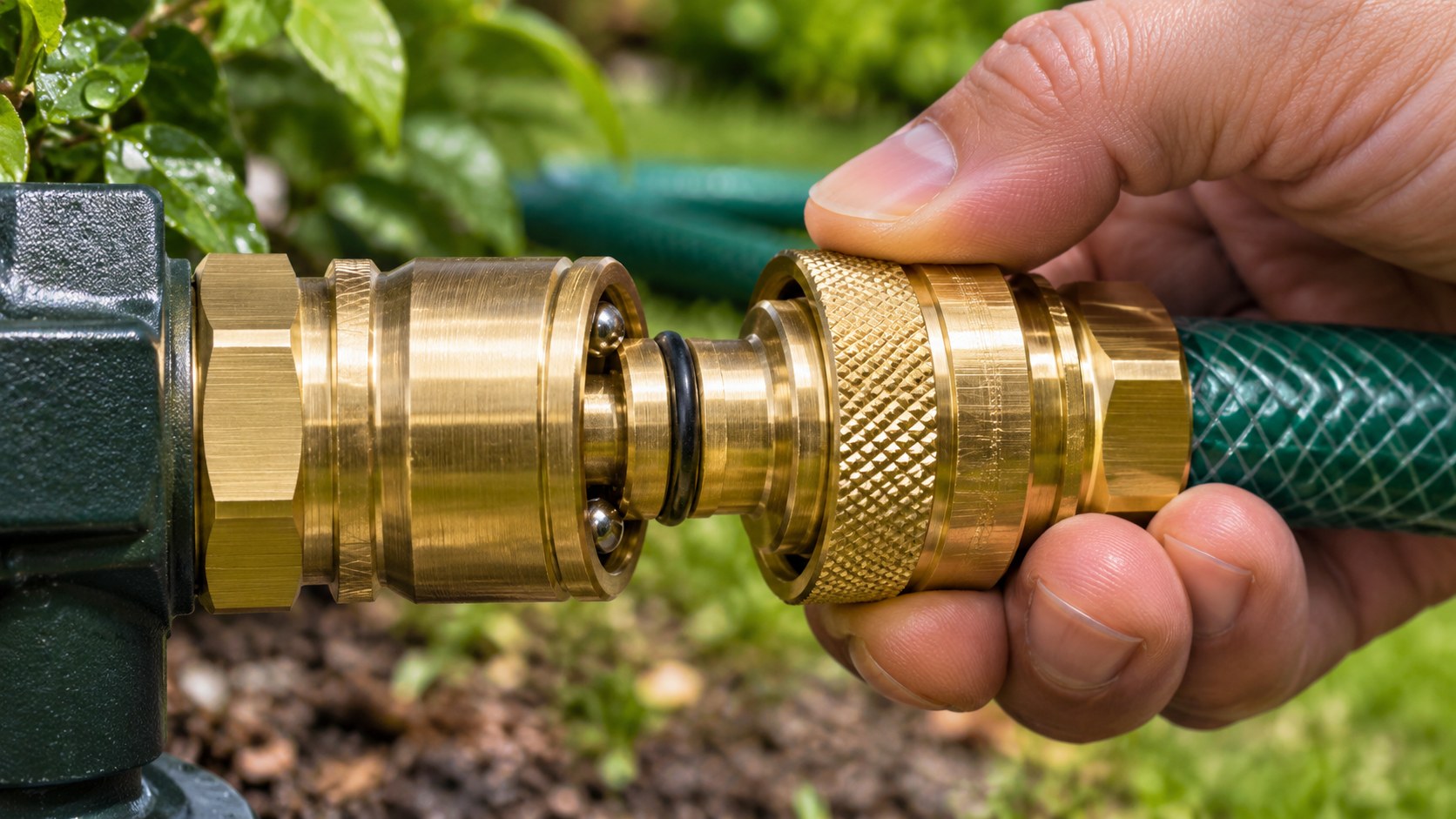
What the sleeve is doing
Many quick couplings use a sliding sleeve to control a set of locking balls or a comparable retainer. Pulling the sleeve back gives the plug room to enter or leave. Releasing it allows the retainer to engage a groove on the plug. The seal is a separate feature, often an elastomer ring inside the socket or on the plug. Engagement and water-tightness therefore need separate checks.
Not every garden connector has the same internal mechanism. Some use molded catches or different release motions. Ask for an exploded drawing or a section view of the actual model before writing operating instructions. The photo of a similar connector is useful for explaining the idea, but it cannot prove the internal design of another SKU.
Seat, inspect, then tug
Begin with water turned off and pressure released. Check that both halves are clean and that the seal is present. Insert the plug squarely using the method specified for that pair. Watch whether the sleeve returns fully and whether the plug shoulder reaches the intended reference position. A partial insertion may produce a sound but leave the retainer only partly engaged.
Next, apply a modest hand pull in line with the connection as a functional check, following the maker’s instructions. The plug should not detach. This hand check does not establish a rated pull-off force. A formal retention test needs a defined fixture, load, duration, specimen condition and acceptance criterion. Buyers who intend to advertise a retention value should request that record for the exact connector pair.
The installed hose can add side load. A connector hanging directly from a heavy hose, timer or tool sees more than an axial pull. Route a sample hose through its expected positions and check whether the sleeve is rubbed by a wall, dragged over an edge or hard to reach with wet hands. Parker’s quick-coupling safety guidance discusses accidental sleeve movement, side loads and dirt for its industrial products. The mechanisms are instructive; its ratings and service rules are not garden-hose product claims.
Why a connector can feel locked and still fail a fit check
A plug can be close enough to enter a socket but have a groove in the wrong place. The sleeve may stop short, a seal may be overcompressed, or a water-stop valve may not open completely. Check engagement depth, groove geometry and seal contact with the actual production pieces. If the plug and socket come from different suppliers, record both model numbers and revision levels. “Standard-looking” is not a specification.
Dirt creates another false impression. Sand can hold a sleeve back or make it stiff to release. A customer may push harder, damaging a seal or catching a plug at an angle. Provide a simple instruction to rinse and inspect a dirty connector after isolating the water supply; do not advise forcing it with pliers. The packaging can tell users to replace a cracked sleeve or damaged plug rather than keep operating it.
A visual check buyers can put on a work instruction
| Check | Expected evidence | Record when it fails |
|---|---|---|
| Plug seating | Shoulder or witness position matches approved sample | Gap, tilt, obstruction |
| Sleeve return | Sleeve rests at its designed locked position | Sticking, incomplete return, grit |
| Hand retention | Pair remains engaged under instructed manual check | Release motion and mating part IDs |
| Water check | No leak at specified test condition | Seal, threaded end or hose-end location |
| Disconnect | Release motion is consistent after pressure is removed | Binding or unusually high effort |
Use a controlled photo of the approved pair to show what “fully seated” looks like. The image should identify model and revision, not a generic stock coupling. If there is no visible reference edge, ask engineering to define another observable method. A gap check that varies with normal manufacturing tolerance should not become an arbitrary pass/fail rule.
Compare failures by the point where they occur
When a sample fails, keep the observation precise. If the plug will not enter at all, check the entry diameter and any damage at its nose. If it enters but the sleeve does not come forward, inspect the groove location, the stop position and the retainer. If it locks but leaks, look at the sealing surfaces and O-ring before blaming the latch. If it releases under a side pull, note the direction of the load and whether something contacted the sleeve. These are different corrective actions, and a single “connector defective” label conceals them.
Ask the supplier to retain failed specimens with their mating halves. Mixing plugs from one lot with sockets from another during an investigation can make the original fault impossible to reproduce. Photograph the parts in their as-received state, then clean them only after recording grit, coating damage or displaced seals. If the connector is sold with a hose, include the hose termination: a loose hose grip can look like a coupling failure when the metal pair itself remained locked.
What to put on the approved-pair drawing
A useful drawing identifies plug outside diameters, insertion depth, locking-groove position, socket stop, seal location and the sleeve’s released and locked positions. Show the dimensions from stable datums that an inspector can actually find. Add a small diagram of the approved mated state with both model codes. The drawing should also say whether the connector may swivel, because a free-turning pair can still be properly locked.
For retail instructions, translate the drawing into one observable action: push until seated, let the sleeve return, then check the connection by hand with the water off. Do not ask consumers to inspect an internal locking ball they cannot see. A photo of the actual production model is more useful than a generic exploded diagram if the goal is correct everyday use.
Cycle-life claims need a protocol
For a connector that will be swapped daily, ask how many connection and disconnection cycles the buyer expects and which failure modes matter. Log initial and final sleeve movement, retention, leakage and seal condition. Use the intended water, temperature and contamination exposure. A cycle count measured on a dry bench cannot automatically support an outdoor service-life claim.
Choose the inspection intervals before the trial starts. A connector may pass at the end yet become difficult to operate for part of the test. Record insertion and release effort at each interval, and note whether the operator had to adjust the sleeve. If a replacement seal is permitted, state when it was fitted; a test with new seals halfway through cannot support the same claim as a test without maintenance. Report the number of specimens and any spread in results instead of quoting the best sample alone.
Hengxin lists hose connector products, but a category photo alone does not establish a locking mechanism or endurance result for every item. To compare candidate parts, send both mating samples, the hose configuration and the proposed pass criteria through the contact form. Ask for the model-specific drawing and test record before finalizing retail language.