
Do not rate a garden hose connector for hot water by looking at its brass body. The assembly also contains a seal, a hose, a clamp or hose grip, and sometimes a plastic sleeve or water-stop valve. Obtain the limits for each part, then test the assembled combination at the intended water temperature and pressure. If those records are absent, describe the product for ordinary garden-water use only.
Where the temperature limit actually sits
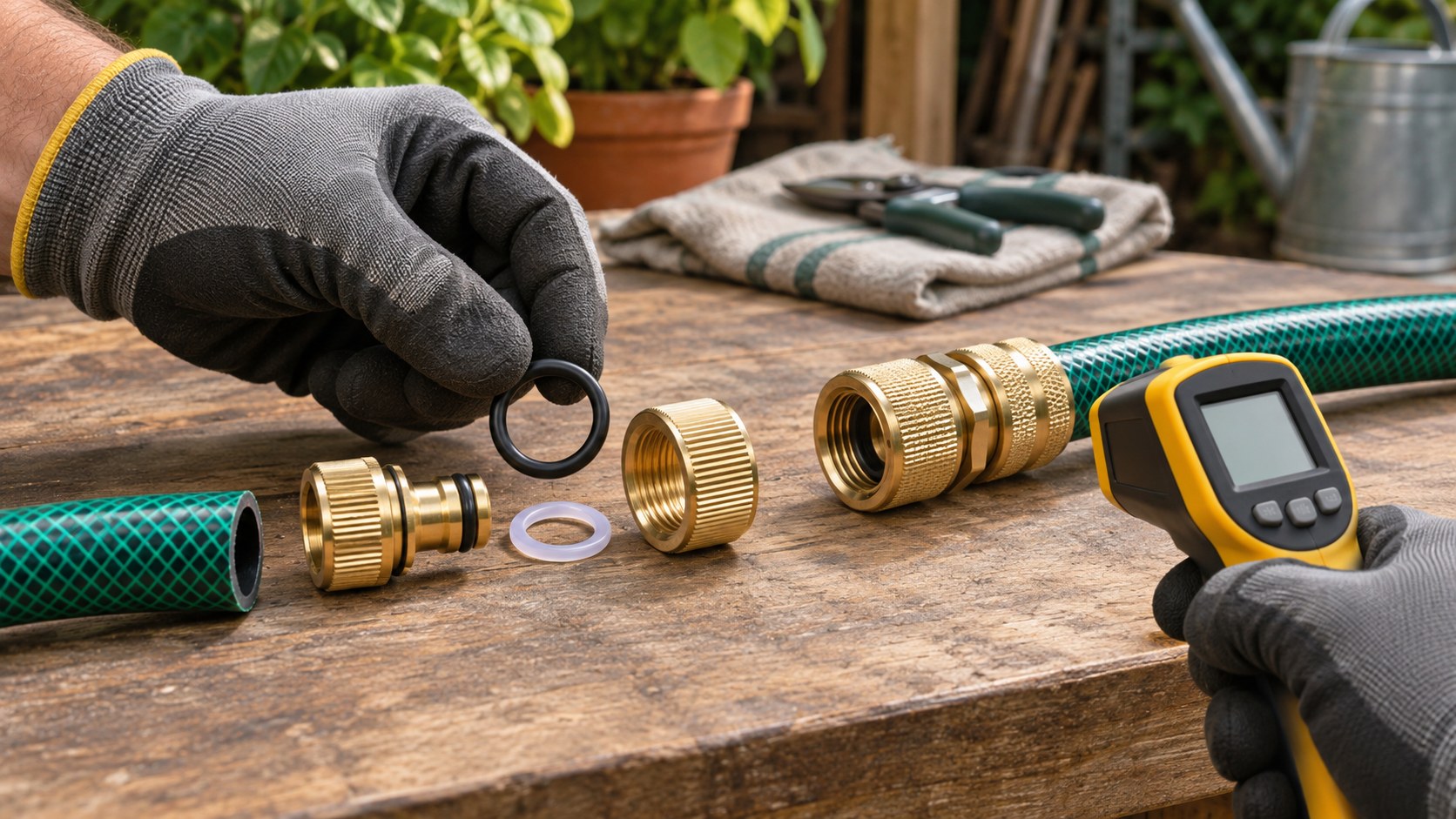
Metal is often the most visible part of a connector, so buyers ask whether “brass can handle hot water.” That question skips the parts most likely to change their behavior with heat. An O-ring can lose sealing force, a soft hose can become easier to pull off a barb, and a plastic grip can distort. The nominal metal grade alone does not supply a finished-product rating.
Parker’s hose safety guide instructs users to keep both steady and transient temperatures within the limits of the hose, fitting and seals. That is a selection principle. It is not a temperature certification for a Hengxin connector. Ask the supplier for the exact elastomer material, plastic resin where used, hose construction and assembled test conditions.
Make the application specific
“Hot water” could mean occasional warm rinsing of gardening tools, repeated cleaning cycles, a permanently heated supply or a steam line. Those are different jobs. Define the maximum incoming water temperature, how long a cycle lasts, how often it repeats, ambient exposure and whether the hose remains pressurized between uses. Include any cleaning chemicals in the request. The acceptable material combination may change with the medium as well as temperature.
Distinguish continuous from intermittent service. A material datasheet that lists a short exposure limit cannot support continuous operation at that temperature. A test at room temperature cannot resolve leakage after thermal cycling. If the application is steam, specify a system designed and rated for steam; a garden quick connector should not be relabeled for that use based on its metal shell.
Check every component in one line
| Component | Evidence to request | Possible failure to watch |
|---|---|---|
| Connector body | Alloy and model drawing | Thread or joint movement |
| O-ring or washer | Material designation and temperature limit in intended medium | Compression loss or swelling |
| Sleeve or grip | Resin and functional test | Binding or incomplete locking |
| Hose | Maker’s rating for water, pressure and temperature | Softening, kinking or detachment |
| Clamp or hose grip | Approved assembly method | Loss of retention after heat exposure |
The table is a review list, not a set of Hengxin specifications. Record the lowest applicable limit of the validated assembly; do not combine the highest limits from unrelated component brochures. If the connector is supplied without a hose, the seller must state the tested hose type or keep the system-level claim conditional.
What the leak test should cover
Agree on test pressure, water temperature, dwell time, number of heating and cooling cycles and inspection points before testing. Inspect the threaded joint, the quick-connect seal and the hose attachment separately. Check whether the sleeve still moves and locks after the hot-water exposure. A connector that does not leak while warm may behave differently after it cools, so include a post-cycle check if the intended use alternates temperatures.
Sample identification matters. Record body and seal revision, hose model, clamp, lot and assembly method. If the buyer changes the hose or seal for cost reasons, the earlier result may no longer describe the shipped product. Ask for the change-control rule in the supply agreement rather than assuming the original approval carries forward.
Two examples of a better specification request
A vague request says “brass connector for hot water.” A useful one says the connector will serve a cleaning hose, lists the incoming-water range, the length and frequency of each hot cycle, the hose model, the nozzle or tool, and the maximum pressure at that temperature. The buyer also tells the supplier whether the connector is normally disconnected while warm. That last detail matters for a quick-release sleeve: heat may alter operating effort even if the joint remains sealed.
For an outdoor tap that occasionally receives warm water, describe the actual source and possible temperature spikes. A solar-heated hose can deliver a brief hot slug even when the tap supplies cold water; it does not follow that the whole garden system is suitable for planned hot-water cleaning. If the application depends on hot-water service, obtain data for that use rather than treating an incidental exposure as qualification.
Questions to close before approving artwork
- Which exact connector and seal revisions are represented in the test?
- Is the published limit for continuous service, short exposure or storage only?
- What hose, clamp and mating tool were assembled with the sample?
- Was leakage checked while hot and after cooling?
- Did the locking sleeve and water-stop valve still function after cycling?
- Does the claim refer only to water, or also to cleaning chemicals?
These answers belong in the product file before a temperature symbol goes on the carton. If a supplier can provide material datasheets but no assembled test, the buyer can still use them to plan validation. The datasheets alone should not be presented as proof that the finished kit passed.
Do not mix cleaning-water and drinking-water claims
A fitting suitable for a garden rinse is not automatically appropriate for potable water. Drinking-water claims depend on the destination market, exact wetted materials and applicable approval route. Likewise, heat tolerance alone does not establish suitability for food contact or sanitation. Keep the intended medium on the drawing and packaging so an attractive brass connector is not marketed beyond its evidence.
Be equally careful with the word “pressure.” A component can have a room-temperature pressure figure and a lower allowable pressure when hot. Check the relevant conditions together. A label that puts the maximum temperature from one document beside the maximum pressure from another may describe a combination that was never validated.
Write the outcome as a conditional product decision: either the exact assembly has evidence for the named application, or the proposed application needs another design or further testing. That decision can be revisited when the customer supplies a different hose or the factory provides a revised seal. It should not be converted into a blanket statement about all brass connectors.
Keep the test close to real handling
Hot water may be present while a worker changes a nozzle or disconnects a hose. If that is the intended use, the test plan should include the operating motion after exposure, with an agreed safe method for the operator. Inspect whether the sleeve can be gripped and released, whether a water-stop valve closes when disconnected, and whether any hot water trapped in the hose drains unexpectedly. These observations belong alongside the leak result; a sealed connector that cannot be safely handled is unsuitable for that use.
Storage also matters. A garden kit may sit in a hot vehicle or in direct sun before installation. State whether the requested temperature limit concerns water inside the assembly, surrounding air, or both. The component maker’s published material range may be useful in screening candidates, but packaging claims should reflect the tested assembled product and the actual intended exposure.
For a quote, submit the water temperature profile, pressure, hose and seal requirements, and the product’s intended labeling. Browse the Hengxin hose connector range for candidate forms, then send the full assembly conditions for model-specific review. Until that review closes, avoid a “hot-water rated” statement.