
A “full-port” or “high-flow” hose splitter should be judged by its narrowest water passage and a comparable flow test, not by the 3/4-inch size written in its title. Two splitters can use the same hose connection yet have different internal paths through the inlet, valve seats and outlets. A wider path can reduce one source of restriction, but it cannot create water pressure or guarantee a particular flow at the end of a long hose. For importers and product managers, the useful question is: which dimensions and test conditions support the claim for the exact model?
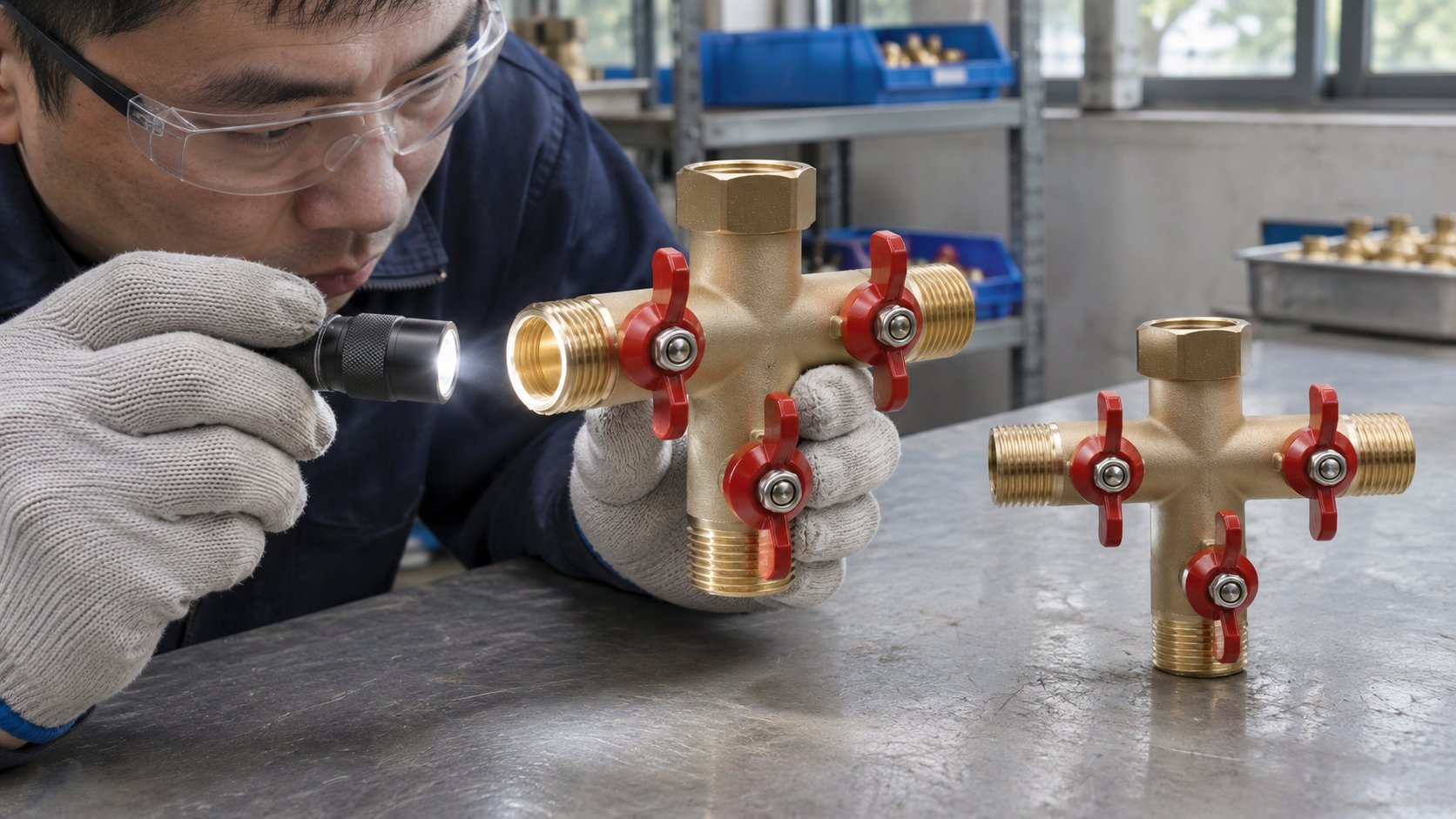
Connection size and water passage are different measurements
A connection label identifies how a fitting mates with another component. It does not describe every opening inside the body. Water can enter through a nominal garden hose connection, pass a narrower inlet throat, turn through a valve, and leave through an outlet with a different effective area. The smallest relevant section may be hidden from a catalog photograph.
Ask for a dimensioned drawing that shows the inlet, each outlet, the valve seat and the minimum internal passage in the fully open position. If there are several outlet paths, the controlling dimension may differ by branch. A single outside diameter or thread size does not prove “full port.” The term also needs a stated definition: full relative to which connection bore, in which valve position and under which model revision?
A cutaway drawing or approved sectioned sample can make the path easier to understand. It should show the real geometry, including changes of direction and valve features, rather than a generic illustration of a straight tube. Until a model-specific drawing exists, describe the need to verify the passage rather than publishing a made-up bore value.
Why the narrowest passage matters, but is not the whole answer
When water flows, restrictions and changes in direction contribute to pressure loss. At the same demand, a smaller opening can increase local velocity and resistance. Yet a single bore measurement cannot predict the performance of the whole installation. The splitter also has turns, valve shapes, washers and connected fittings; the hose has its own length and internal diameter; the available supply changes with other water users.
Consider two catalog candidates with identical external hose threads. One may use a narrow valve opening and the other a wider opening. If all other relevant conditions are equal, the wider path may impose less restriction at a given flow. The comparison is only valid when the models are tested in the same fixture. Do not claim a percentage improvement from visual inspection or a competitor’s published value.
A splitter with several open branches introduces another question: how much water does the source supply when both or all outlets are drawing? Each branch sees the pressure remaining after losses upstream of it. Opening another branch can change the flow in both. It is misleading to present a one-branch result as the performance of a two- or four-branch installation.
Measure the passage on the correct model
Start with the exact part number, revision and outlet configuration. Obtain the engineering drawing or an approved sample that identifies accessible bore dimensions. Measure or document the minimum passage along each flow path with an appropriate method; do not place a caliper on the external thread and call that the internal bore. Some valve openings are irregular rather than circular, so a simple diameter may not capture the actual flow area. Record how the dimension was defined.
If a supplier uses “full-port” as a sales term, ask what it means for that product family. It may refer to the valve opening relative to the inlet, but definitions vary across designs. A buyer should ask for a drawing and a measurable comparison, not assume a universal standard from the phrase alone. Also confirm that the stated dimensions apply to every material, handle and thread variant in the quotation.
For a kit, include the narrowest passage in adapters, quick connectors, timers and hose ends. A wide splitter body offers little system benefit if a downstream accessory creates a tighter restriction. This is particularly important when a buyer combines parts from several suppliers. The splitter category helps identify candidate layouts, while drawings and samples establish the passage for each SKU.
Run a flow comparison that can be repeated
Choose the buyer’s intended configuration and write down the test setup before comparing models. Use the same water source or controlled supply, the same inlet pressure measurement point, the same hose and accessories, and the same outlet positions. Measure flow at a defined outlet or collection point. If the purpose is to compare one branch, keep the other branches in the same state for both samples. If simultaneous use matters, test that state separately.
| Record in the test report | Why it matters |
|---|---|
| Model, revision and connection variant | Keeps the result tied to the item actually quoted |
| Supply and inlet pressure measurement | Shows the operating condition at the splitter |
| Which outlets are open | Separates single-branch and simultaneous use |
| Hose length, bore and attached fittings | Accounts for restriction outside the splitter |
| Flow measurement point and method | Makes the result repeatable and comparable |
| Outlet pressure, where measured | Shows the pressure available to the downstream component |
Use more than one flow condition if the product will serve a range of applications. Pressure drop is not a fixed property that can be detached from flow. A curve or table pairing measured flow with inlet and outlet pressure is more useful than a single claim such as “no pressure loss.” The test method and instrument details should accompany the data. Results without the setup may still be a demonstration, but they should not support a numerical marketing comparison.
Repeat the test with representative production samples if the claim will be used on packaging. A prototype result should not automatically become a promise for every production batch. If the supplier cannot provide a controlled result, the safer editorial choice is to describe the selection criteria and hold the quantitative performance claim.
Keep raw measurements alongside any rounded values used in a sales sheet. Rounding can make two close results look equal or exaggerate a small difference. If the test is run on different days, note changes in the supply and equipment. This record helps an engineer decide whether a measured difference is meaningful before the marketing team turns it into a headline.
Include the hose and accessories in the decision
Water leaving the splitter still travels through a hose, nozzle, sprinkler, timer or irrigation component. A long or narrow hose can impose substantial resistance. A water-stop quick connector, small timer port or partially closed valve can also limit the final flow. The system should therefore be evaluated at the point where performance matters, not only at the splitter’s bare outlet.
For a sprinkler kit, check the sprinkler’s required operating conditions and the pressure available at its inlet during use. For simultaneous branches, check the total demand against the supply and compare the actual layout. A full-port splitter is one component in that chain. It cannot make an undersized water source supply more water than it can deliver, and it cannot correct a restrictive hose or accessory downstream.
When sales teams compare products, keep the metric consistent. “Flow rate with one outlet open,” “flow with both outlets open,” and “pressure loss at a specified total flow” answer different questions. Publishing them as if they are interchangeable can mislead a distributor into selecting the wrong model for its customers.
What to request in a sourcing file
Ask each candidate supplier for the model drawing, a description of the internal passage, thread and seal specifications, and flow data under stated conditions. Record the buyer’s target country and mating connection separately. A product that fits the market’s hose thread still needs to be checked against the intended timer, hose and outlet accessories.
For an OEM or private-label range, keep the approved sample, model revision and test report linked to the artwork. If the body, valve, washer or thread configuration changes, review whether the old “full-flow” copy still applies. The documentation should say what was measured and what was merely observed. Avoid carrying a number from a similar product or from a competitor into a new SKU.
Buyer questions about full-port splitters
Does a 3/4-inch connection guarantee full flow?
No. The nominal connection describes a mating interface; it does not reveal the narrowest internal passage through the inlet, valve and outlets. Ask for a drawing and comparable flow data for the exact model.
Which conditions should a flow comparison state?
At minimum, identify model and revision, inlet pressure and its measurement point, outlet configuration, hose and fittings, flow measurement point and method. For multiple branches, state which outlets were open.
Can a splitter increase supply pressure?
No. A splitter divides a water supply among branches and introduces some resistance. A better-matched flow path may reduce restriction compared with another assembly, but it cannot raise the upstream supply pressure.
To compare Hengxin splitter candidates for a wholesale range, send the intended outlet count, target market, connection drawings, attached accessories, simultaneous-use pattern and estimated quantity through the contact page. Request model-specific passage dimensions and test records before using “full port” or a numerical flow claim in a listing.