
A hose splitter can feed two soaker-hose runs from one outdoor tap, but the number of outlets does not tell you whether both beds will receive useful water. The soaker hose model, run length, inlet conditions, terrain and simultaneous demand all matter. Start with the hose maker’s operating instructions and a drawing of the garden layout. Then use the splitter to create controllable branches and test the complete assembly at the far ends. For a distributor, this is a kit-design question as much as a fitting-selection question.
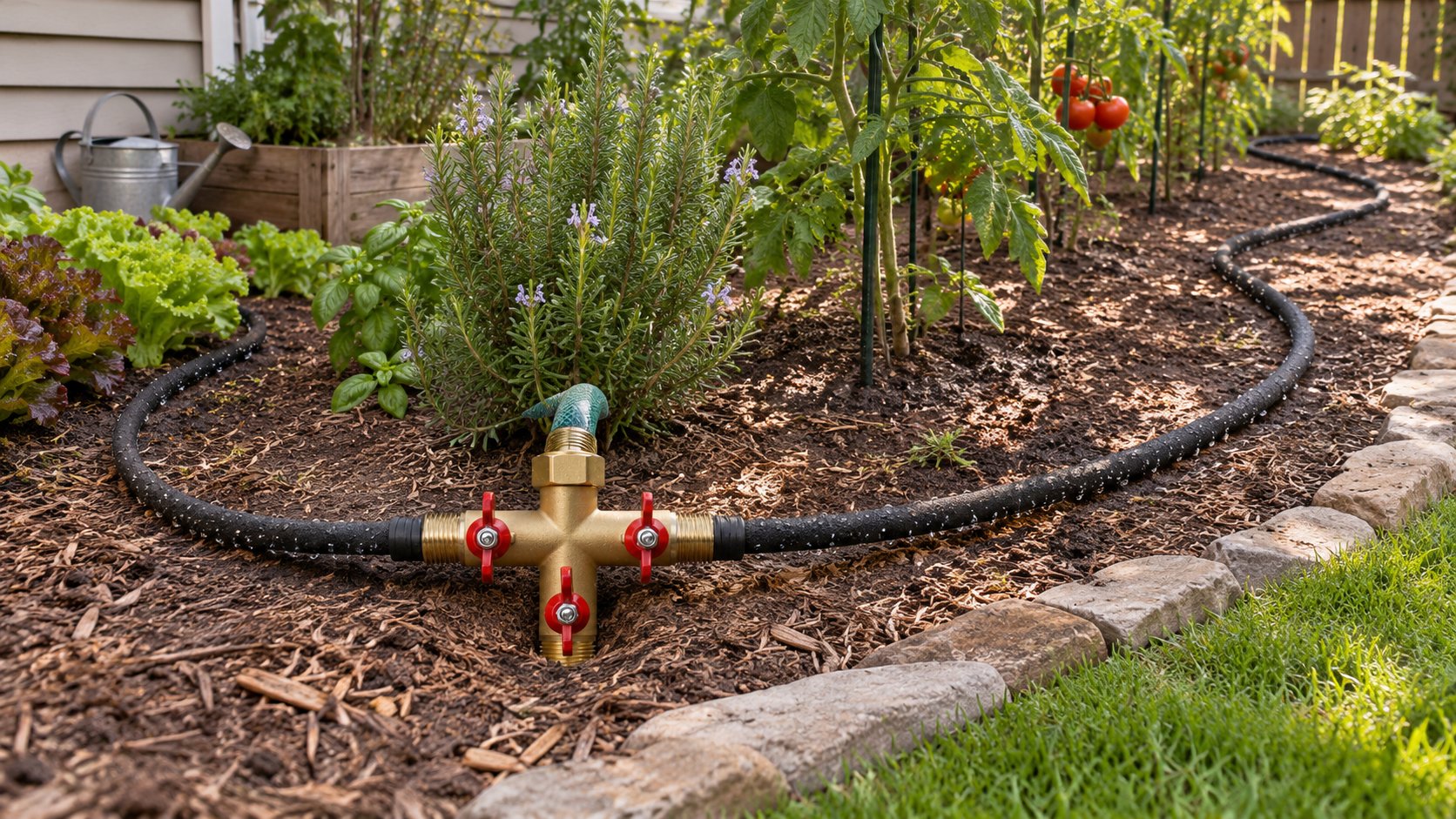
Start with the exact soaker hose, not a generic length rule
Soaker hoses release water along their length. Their construction, pore pattern and allowed inlet condition vary by product. A length that works for one hose may not work for another. For example, GARDENA describes a maximum extension for one named soaker-hose model; that figure belongs to that model and should not be copied into a universal splitter specification. Obtain the current instructions for the hose actually included in the proposed kit.
Record the total length of each branch, including any ordinary supply hose before the porous section. Note the number and location of connectors, end caps and turns. A long feed hose and several small fittings can change the condition at the soaker hose inlet even if the splitter itself has a generous passage. If the far end of one run stays dry, adding another splitter outlet will not address the real constraint.
Check whether the hose maker specifies a pressure-control device, a recommended inlet range, a maximum run length or a particular connector system. Follow those instructions for that hose. A splitter’s manual shutoff valves are useful for isolating beds, but they are not a substitute for a regulator where a stable inlet condition is required.
Compare symmetric and unequal branches
Two beds of similar size can be served by comparable soaker runs, yet equal splitter outlets alone do not guarantee equal wetting. The branches may differ in length, elevation, supply-hose diameter or fitting count. Draw each path from the splitter to the end cap and mark the porous portion. Run each branch separately first. This establishes whether each route works on its own before both are opened together.
| Layout | First question to test | Practical observation |
|---|---|---|
| Two similar-length runs | Do both have comparable inlet conditions and connectors? | Compare the wetting pattern along both beds with one branch open at a time. |
| One short and one long run | Does the long run still wet near its far end? | Test the long branch alone, then repeat with the short branch open. |
| Runs at different elevations | Is the upper run receiving enough water under use conditions? | Observe both ends and record the elevation difference. |
| One soaker run plus a hand hose | Does occasional hose use disturb the soaker branch? | Open the hand hose as a user would and check the soaker inlet condition. |
When branches are unequal, do not assume that partly closing the shorter branch creates a properly controlled supply for the longer one. A valve position can change the distribution under one tap condition, but the result may shift when the source pressure or downstream use changes. If equal delivery is essential, have the irrigation designer specify and verify the control arrangement.
Diagnose weak water at the far end in a fixed order
First check whether the problem occurs with the affected branch alone. Close the other splitter valve and operate the one soaker run as instructed by its maker. If the far end remains weak, inspect the water source, inlet connection, filter if fitted, supply hose, kinks and soaker-hose length. Confirm that the end cap is installed correctly and that there are no unintended leaks near the inlet. A loose connector can waste water before it reaches the porous section.
Second, compare the run against the product’s own length and operating guidance. Do not use a supplier’s photograph to infer an approved maximum length. If the hose is longer than the maker permits, divide the bed into shorter zones or select a suitable product rather than promising that a larger-looking splitter will solve it. If the length is within guidance, inspect the route for crushed sections, sharp bends, blocked connectors or sediment accumulation according to the hose instructions.
Third, open the second branch and repeat the observation. A run that works alone but weakens when both branches operate points toward shared supply capacity or added restriction in the complete assembly. Measure the relevant flow and pressure at defined locations if performance must be guaranteed. The observation by itself does not identify which component causes the loss.
Finally, check the wetting pattern over an appropriate watering interval. A soaker hose is meant to wet soil gradually; a quick glance immediately after opening the tap can mislabel normal behavior as failure. Keep timing, soil condition and the position along the bed in the record so comparisons are meaningful.
Why the splitter valve is not a pressure regulator
A branch valve changes the opening through which water passes. It can reduce flow and can be useful for on/off control or rough balancing. It does not automatically hold a selected downstream pressure as upstream pressure or other branch demand changes. A pressure regulator is a separate component selected for the irrigation system’s required range and flow. The US EPA microirrigation guide explains why a regulator, filter and backflow protection may be needed at a hose-bib source; the exact arrangement depends on the system and local requirements.
Do not label a splitter handle setting as a pressure value without measurement. The same handle angle can produce a different downstream condition after a second branch is opened. In a kit manual, explain the function of each component separately: splitter for branch selection, pressure-control device where specified by the hose maker, filter where required, and the applicable backflow device for the water source.
Build and check one representative kit
Use the actual tap connection, splitter, hoses, connectors and end caps proposed for sale. Confirm thread form and sealing face for the target market; nominal size is not enough to prove a connection. Attach the assembly without forcing misaligned parts. Check that both valves and hose connections can be reached after the splitter is mounted. If a long hose pulls on an outlet, reroute or support it so the tap is not used as an improvised bracket.
Open one branch at a time and inspect for leaks at the tap, splitter inlet, branch outlets and every hose connector. Then open both branches and record the observation at the beginning, middle and far end of each soaker run. If the product claim needs a numerical delivery or uniformity statement, use a defined measurement method, repeat it with representative samples and retain the raw results. A wet patch in one photograph is not a substitute for a test report.
Change one variable at a time when troubleshooting: hose length, connector, valve position or simultaneous use. Otherwise, a successful retest cannot be tied to a clear cause. Include the hose model and revision in the report, as the same brand can sell several constructions under similar product names.
Drain the assembly before freezing weather
Follow the hose manufacturer’s winter-storage directions and local climate requirements. Shut off the water, relieve pressure and disconnect the hose and splitter as appropriate. Drain water from the splitter’s inlet, outlets and valve cavities by orienting it so water can leave; open the branch valves only when the supply is isolated. Drain and store the soaker hoses according to their instructions. Trapped water can freeze and damage a pressure-containing fitting or hose even when the outer surface looks sound.
Inspect the splitter and connectors before the next season. Check washers, seals, threads and the body for cracking. Replace a visibly cracked pressure-containing part rather than using tape or adhesive as a permanent repair. If a retailer receives winter-related returns, record the storage and installation conditions instead of assuming that every leak has the same cause.
A distributor’s accessory checklist
A sellable kit needs more than a two-way splitter. List the exact soaker-hose model and length for each branch, supply hose if used, compatible connectors, end caps and any adapters. Add the filter, pressure-control and backflow components specified for the design; identify any items sold separately. Include the target-market thread and seal description, installation diagram, approved branch length and winter-care instructions. Keep the approved sample and bill of materials together.
When sourcing the splitter, ask for the current drawing, connection details, valve operating instructions and model-specific test records. The Hengxin garden hose splitter range is a starting point for outlet layout. The hose manufacturer’s instructions decide the soaker-run limits. Avoid a broad “works with every soaker hose” claim unless each intended combination has been checked.
Questions buyers ask
Can one splitter run two soaker hoses at once?
Yes, if the tap supply and complete assembly meet both hoses’ operating requirements. Check each branch alone, then both together, using the exact hose models and lengths.
Will turning one splitter valve down regulate the soaker hose?
It can restrict a branch but does not hold a constant downstream pressure. Use the pressure-control arrangement required by the soaker-hose design.
Why does only the near end of a soaker hose get wet?
Check the run length against the hose maker’s guidance, then inspect the inlet, supply hose, kinks, connectors, filter and simultaneous demand. Record the observation over a meaningful watering interval.
For an OEM or wholesale kit, send the target market, tap connection, soaker-hose model, branch lengths, expected simultaneous use and order quantity through Hengxin’s contact page. Request a splitter drawing and sample to verify with the selected irrigation components.