
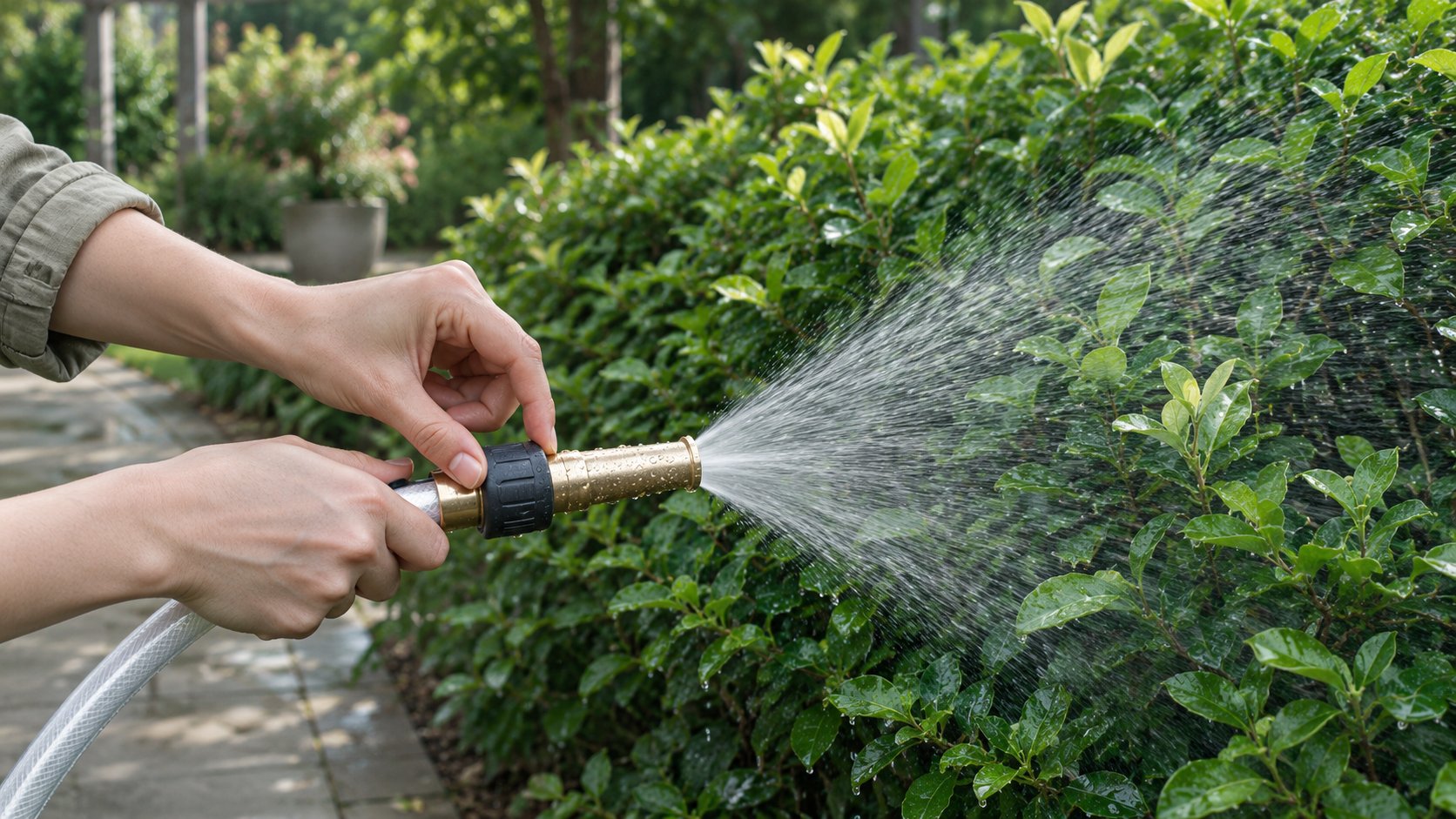
A twist hose nozzle changes its outlet opening as the user turns the barrel or tip. Depending on the model and water supply, the same nozzle may produce a fine mist, a wider fan or cone, and a concentrated jet. Those names describe useful operating zones, not guaranteed identical patterns on every tap. For buyers comparing adjustable nozzles, the honest way to show the change is to photograph the exact model at recorded inlet pressure and flow conditions, then test how each setting serves a watering or cleaning task.
Follow the adjustment from closed to open
Begin with the nozzle connected to a compatible hose and tap, the water source shut off and the twist tip in the position specified by the maker. Open the source, then turn the tip gradually through its normal adjustment range while pointing it in a safe direction. Observe how the stream changes. Some models pass from closed to jet, then to a wider fan or mist; others use a different sequence. Do not print a setting sequence based on a similar-looking nozzle without testing the SKU being sold.
Mark several repeatable positions on a test sample or record the number of turns from a defined stop without forcing the tip past its limit. Take a photograph at each position with the same camera location, background, hose and source condition. This produces an honest comparison. A marketing image assembled from unrelated spray effects can exaggerate coverage and mislead a distributor deciding between designs.
| Observed pattern | Typical user task to evaluate | What to check |
|---|---|---|
| Fine mist | Gentle watering of delicate foliage or seedlings | Droplet spread, overspray and effect at the actual working distance |
| Wide fan or cone | Covering a broader bed or rinsing a surface | Evenness and whether the width remains useful under the site’s supply |
| Focused jet | Targeted rinsing or reaching farther | Range, impact and risk of damaging plants or soft surfaces |
| Closed position | Pausing flow briefly during work | Leakage and the maker’s limits for remaining pressurized |
Why the same nozzle looks different on another tap
The pattern depends on the water arriving at the nozzle. A long narrow hose, timer, splitter, quick connector or partly closed tap can change the flow available. Static tap pressure alone does not describe the condition while water is spraying. Measure pressure at a defined point during flow and note the hose and accessories. Without this information, two spray photographs from different gardens are not a fair comparison of nozzle geometry.
At a low available flow, a setting labeled “mist” may produce coarse droplets or an uneven fan. At a higher supply, a jet may reach farther and strike with greater force. Neither observation should be converted into a universal distance or cleaning claim. If a buyer needs a performance range, test the product at the relevant inlet conditions and state those conditions beside the result.
Nozzle wear and debris can also change the pattern. Before blaming a poor spray on the design, check the tip for dirt according to the manufacturer guidance and inspect the hose-end washer and connector. A partially blocked opening may make a fan asymmetric. Do not enlarge the outlet with a tool; that would alter the product and invalidate a comparison.
Match the pattern to the task
For seedlings and fragile foliage, evaluate a gentle pattern at the user’s actual working distance. A mist that looks soft in a close-up photograph can still displace soil if the user holds the nozzle too near, and a very fine spray can drift in wind. For established beds, a wider fan may cover more area with less repeated hand movement. Observe the soil response, not just the spray shape against a dark backdrop.
For rinsing tools or a path, a focused jet may remove loose dirt more effectively than a mist, but it is not a pressure washer. Avoid pointing a concentrated stream at people, fragile plants, painted surfaces or electrical equipment. Cleaning effectiveness depends on flow, distance and the nature of the dirt. A nozzle should be presented as a garden-hose accessory with a defined use case, not as a replacement for specialized high-pressure equipment.
Distributors can offer a twist nozzle when simple one-handed adjustment and compact storage are valuable. Check grip under wet conditions, adjustment torque, stop positions and whether the user’s hand can remain away from the stream. If the product will be used by a nursery crew throughout a shift, test repeated adjustment and hose strain as well as the photographable spray pattern.
Use controlled photos and measurements for a product listing
For each spray photo, record the nozzle model and revision, inlet pressure measurement point, flow or supply condition, hose length and bore, connected fittings, camera distance and nozzle setting. Use the same background and exposure if the purpose is comparison. A photo of a strong-looking jet under one source condition should not be placed beside a mist shot taken on another tap without disclosure.
Where a product listing says “three patterns,” check whether the model has three stable positions or a continuous adjustment range with three descriptive examples. If it is continuous, wording such as “adjusts from a focused stream toward a wider spray” may be more accurate than implying discrete detents. Keep measured performance separate from descriptive pattern names.
Request real sample photography for the final SKU. The images accompanying this guide are illustrative and should not be treated as spray-test evidence. In a buyer file, retain unedited comparison photos or video and the original measurement record. A render can explain mechanism but cannot establish flow, coverage or range.
Understand the closed position and supply pressure
Some twist nozzles can close the outlet as the tip is turned. That can be convenient for a brief pause, but it leaves the hose and upstream connections under pressure if the tap remains open. The maker’s operating and storage instructions determine whether the nozzle may be left closed under supply pressure and for how long. A general product page should not imply that a closed nozzle is a permanent shutoff for an unattended system.
Turn off the water at the source when finishing work, relieve pressure as instructed and disconnect or store the assembly according to the product guidance. If the tip leaks in its closed position, first locate whether water is coming from the nozzle outlet, the adjustment seam or the hose coupling. A washer at the hose end will not repair a damaged internal closure seal. For an OEM range, request the model’s shutoff leakage test and cycle criteria before advertising “leak-free closed.”
Build a buyer’s test matrix
Test representative samples at defined low, typical and high inlet conditions within the product’s documented rating. Record pressure while water is flowing, flow through the nozzle, setting position, pattern width or reach if measured, and visible leakage. Repeat after a specified number of twist cycles if durability is part of the claim. Keep the hose and fittings constant across samples.
Observe whether the tip can be adjusted without excessive force and whether a small change in rotation causes an abrupt spray change. Check for drips at the hose connection and the rotating tip separately. If an OEM buyer wants a particular mist droplet size or jet range, agree on a test method and acceptance criteria before production. The phrase “adjustable” alone does not answer those performance questions.
Compare the tested sample with the Hengxin twist hose nozzle range and the broader garden hose nozzle category. Request model-specific drawings, rated conditions and sample images for the exact version being quoted.
For a nursery buyer, repeat the test after a realistic work interval. Note whether the grip becomes slippery, whether the selected pattern stays stable, and whether the hose coupling begins to loosen as the operator turns the nozzle. Run the comparison on a representative hose length rather than a short laboratory lead. A pattern that photographs well for a few seconds may still be awkward to use across many plant rows.
Keep the original video of the full adjustment travel. It can show intermediate patterns and drips that a set of three still images misses. If the final product uses a different tip or internal seal from the approved sample, repeat the spray comparison before reusing the images.
Questions about twist nozzle patterns
Does every twist nozzle have mist, fan and jet settings?
No. These are useful descriptions, but the available sequence and whether settings are discrete or continuous depend on the exact nozzle model. Test the SKU and describe what it actually does.
Will the jet look the same on every hose?
No. The available supply, hose length and bore, connected accessories and nozzle setting affect the result. State test conditions when showing spray comparisons.
Can I leave a twist nozzle closed with the tap on?
Follow the maker’s pressure and storage instructions. Closing the nozzle does not depressurize the upstream hose or connections; shut off the source when watering is finished.
For a wholesale nozzle range, send the target market, expected hose and fitting setup, desired spray tasks, required test conditions and order quantity through Hengxin’s contact page. Ask for a tested sample and real spray comparison images before approving product claims.