
When choosing a garden hose mender, measure the hose that will grip the repair fitting. A 3/4-inch garden-hose thread on an end repair part describes its connection to a tap or accessory; it does not tell you which hose inner diameter the repair shank fits. An inline joiner may have no garden-hose thread at all. Select by hose construction, inner diameter, wall thickness and the mender’s retention method, then test the repaired assembly. A label based only on the thread can send a buyer the wrong kit.
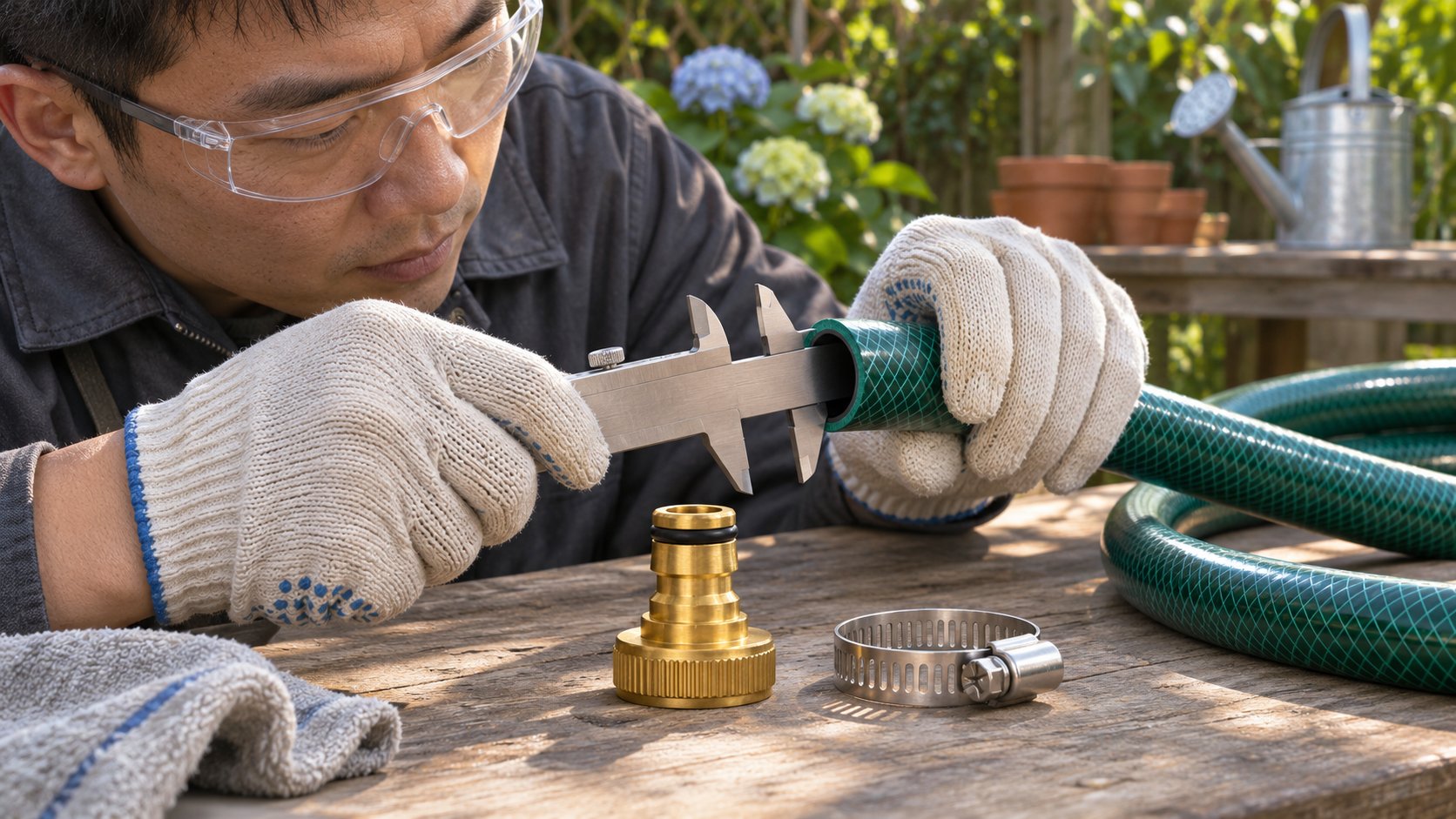
Separate hose size from thread size
A hose has an inside opening, a wall and an outside diameter. A threaded hose end also has a mating thread and a seal. These dimensions answer different questions. The barb or insert must suit the hose’s inside diameter and material; the clamp or compression nut must suit the wall and outside diameter; the threaded end must match the tap or tool. A single “3/4 inch” marking is ambiguous unless it says which feature is being measured.
Ask the customer for the hose brand, model and printed size, then measure a clean, undeformed cut section if the maker permits repair. Measure the inside diameter at more than one orientation, the wall thickness and the outside diameter. A hose that has been stretched over an old fitting can give a misleading reading; cut back to sound material first. Material stiffness and reinforcement also matter because two hoses with the same nominal bore may behave differently on a barb.
Some specialty hoses are not intended to be cut and repaired with a generic mender. Hozelock’s guidance for one expanding hose specifically says not to cut that product for a generic repair. Follow the hose maker’s instructions before applying a standard garden-hose repair method.
Choose the correct repair location
An inline mender joins two cut hose ends after a damaged middle section is removed. It needs a retention method on each side. An end repair fitting replaces a damaged male or female hose end and adds a threaded or quick-connect interface. These products can look related in a catalog but do different jobs. A double-ended inline barb cannot replace a threaded tap coupling without another fitting; a threaded end repairer is not automatically suitable for a mid-hose splice.
| Repair task | Fitting to evaluate | Dimensions to confirm |
|---|---|---|
| Hole in the middle of a standard hose | Inline mender with two hose grips | Hose inner diameter, wall, outside diameter and both retention points |
| Damaged male hose end | Male-end repair fitting | Hose fit plus external thread and end-face seal |
| Damaged female hose end | Female-end repair fitting | Hose fit plus internal thread, washer seat and swivel if present |
| Specialty or expanding hose | Maker-approved service part, if any | Product-specific construction and repair instruction |
GARDENA describes cutting out a damaged section and inserting a repairer for one of its hose models. That illustrates the inline repair sequence; it does not establish that another brand’s mender fits every hose marked with the same nominal size.
How a barb and clamp work together
A barb gives the hose material a shaped surface to grip. The hose should seat to the depth specified for the fitting; a clamp or other retainer then keeps the hose from slipping and helps maintain the seal. Match the barb’s profile and outside size to the hose inner diameter. A barb that is too large can split or overstretch the hose; one that is too small may leak or pull out even when a clamp is tightened. Check the manufacturer’s dimensional guidance rather than selecting by eye.
Place the clamp where the fitting maker specifies, normally over the engaged hose and barb, away from an unsupported cut edge. Tighten evenly using the specified tool and method. Excessive tightening can cut into the hose, distort the wall or create a leak path. A clamp that is merely snug on the outside but does not secure the hose against the barb is also inadequate. The correct result is a tested assembly, not a particular number of turns guessed from a photograph.
Some menders use compression-style union nuts instead of a separate metal clamp. Follow that design’s assembly sequence. Do not add a clamp to a fitting unless its maker permits it, and do not omit a clamp from a barb design that requires one. The packaging and parts list must make the retention method clear.
Prepare the hose without creating a new leak
Shut off the water and relieve pressure. Identify the damaged section and cut back to sound hose material using a tool that leaves a clean, square end. Avoid crushing reinforcement or leaving a jagged edge. If the hose wall is cracked far beyond the visible hole, a short splice may not restore it. Inspect the cut end for delamination or deterioration before pushing on the fitting.
Insert the barb to the required depth on both sides of an inline repair. If the fitting instructions call for a safe lubricant or warming method, follow them; do not improvise with chemicals that may damage the hose. Apply the supplied clamp or nut as specified. Keep the two hose sections aligned so the repaired area is not bent sharply as soon as water is turned on. A repair fitting should not be used as a handle for pulling the hose.
Open the water slowly and inspect both sides of the repair at rest and during representative flow. Look for seepage and movement of the hose on the barb. If a threaded end was replaced, inspect that separate washer-sealed or model-specific connection too. A dry barb joint does not prove that the new female coupling seats correctly on the tap.
Measure more than nominal inner diameter for OEM fit
For a buyer designing a kit, request a dimensional drawing of the barb’s crest, root and insertion length, the hose range it is approved for, and the clamp or nut size. Record the hose wall and outside diameter range, construction and hardness information where the hose maker supplies it. A thick reinforced hose may require a different retainer from a thin soft hose even if the printed inside diameter matches.
Test the proposed repair on the real hose models sold in the target market. Check installation effort, leak behavior, pull-off resistance under a defined method and behavior after repeated bending if the use case requires it. Retain the test conditions and sample revisions. Do not claim a universal size range from one easy fit on a bench. A retailer’s return data is useful only when the actual hose models are recorded.
Ask whether the brass mender is intended for potable-water contact before making any such claim. Material appearance alone does not establish that use. The Hengxin connectors and fittings category can help identify candidate repair parts, while model drawings and sample tests establish compatibility.
Write a retail compatibility label
The front label should say “inline repair” or “male/female end repair,” name the hose inside-diameter range supported by the exact part, and identify the retention method. If the end fitting has a thread, state its standard separately. List the clamp quantity or compression nuts included. Do not use the thread size as the only large size marking, since a shopper may interpret it as the hose bore.
The back panel should show a simple cut, insert, secure and test sequence for the approved hose type. Include a warning to shut off the water and relieve pressure before cutting. State any hose constructions excluded by the supplier’s test or the hose maker’s instructions. If the kit is sold across markets, localize the thread standard and hose size clearly rather than assuming one regional label is universal.
Include a scale drawing or a sizing window only if it is printed accurately and remains accurate after packaging changes. A buyer should compare the hose’s printed model and measured cut end with the listed fit range. Do not use an image of a thick reinforced hose to imply that every hose with the same inner diameter has passed a pull-off test. For returns, ask customers to retain a short piece of the original hose so the material and wall can be checked.
Questions about hose mender sizing
Does a 3/4-inch hose thread mean a mender fits a 3/4-inch hose?
No. Thread size describes the external mating connection. Confirm the hose inner diameter, wall and the mender’s approved hose range separately.
Can I tighten the clamp until the hose stops leaking?
Follow the fitting maker’s placement and tightening guidance. Over-tightening can damage the hose wall; a wrong barb size or damaged hose will not be made reliable by more force.
Can every hose be repaired with an inline mender?
No. Specialty constructions may require a maker-approved service part or may not be cut for repair. Check the hose manufacturer’s instructions first.
For a wholesale repair kit, send the hose models, measured inner and outer dimensions, repair location, target market and expected order volume through Hengxin’s contact page. Ask for barb drawings, clamp specifications and samples tested on the intended hoses.