
A male-to-male garden hose connector is useful when two female hose couplings need to meet, such as joining two compatible hose ends or adapting a female-ended accessory to another female-ended line. Its two external threads do not, by themselves, prove that the assembly will seal. Confirm the thread specification on both ends, the sealing faces, washer positions and available engagement length. For a wholesale order, the drawing should describe each end separately, even if the finished part looks symmetrical.
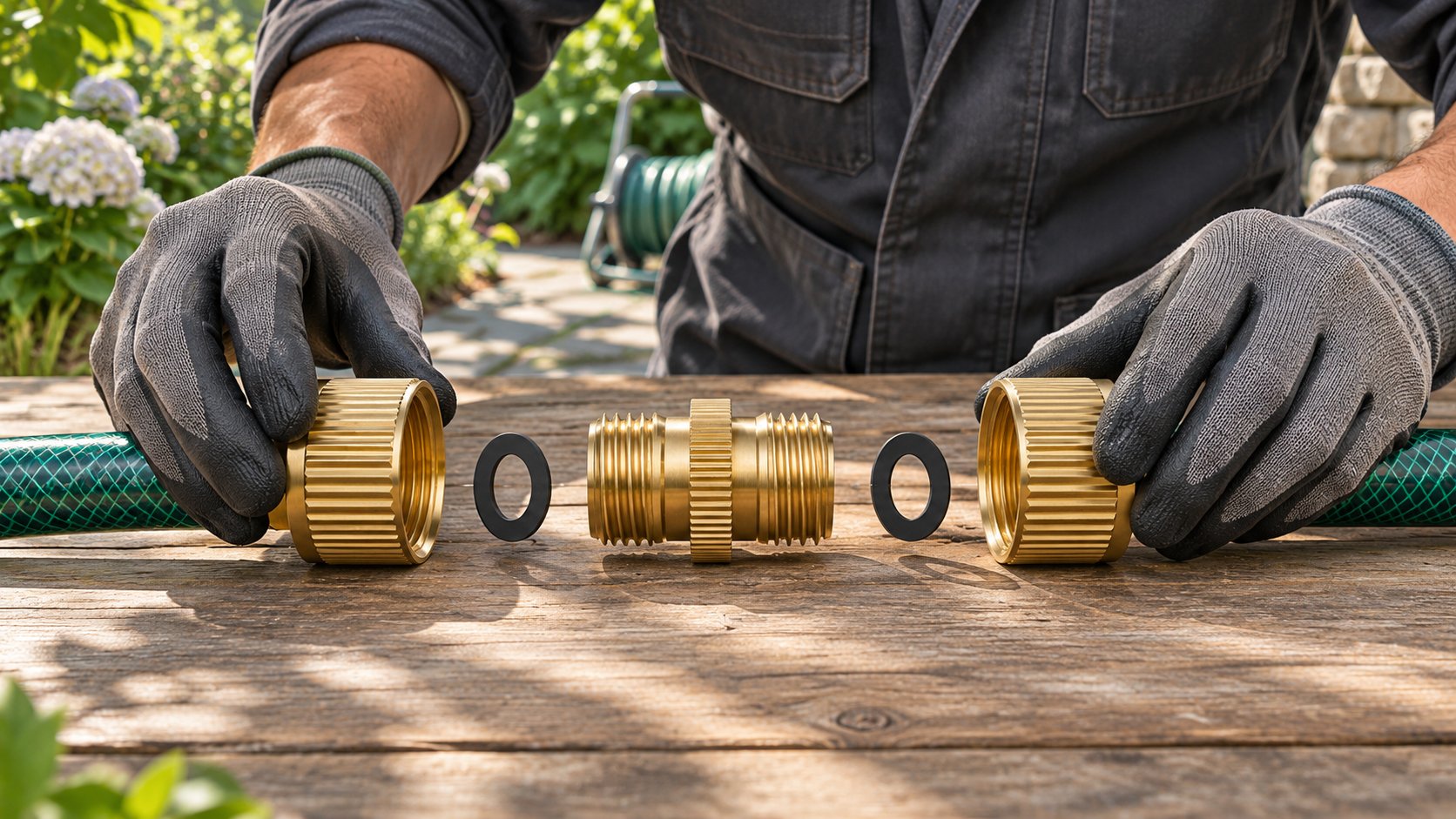
Start with the connection sketch
Draw the route before choosing a double-male part: female hose end → male side A of the joiner → male side B of the joiner → second female hose end. Mark where each washer is located. In a typical garden-hose washer connection, the female coupling holds a flat washer that is compressed against the male end face. The threads bring those faces together; the seal is not created simply by filling the thread gaps with tape.
The sketch should also show whether a hose or piece of equipment can rotate during installation. Two fixed female ends may both need to turn onto the joiner, which can twist a hose or make the last connection awkward. A swiveling female hose coupling may make assembly easier, but its own seal must be checked. A physical sample trial catches these handling details before a kit is approved.
A double-male connector should not be ordered just because an installer sees two female openings. A pipe-thread female port, a garden-hose female coupling and a proprietary quick-connect socket may look similar in a photograph but require different mating parts. The existing Hengxin thread-system guide introduces GHT, NPT, BSP and hose-barb differences; the exact drawing remains decisive.
Check both thread systems independently
Identify the intended standard for side A and side B. A same-standard garden-hose joiner may have nominally identical male ends. A transition adapter may deliberately use different standards, and the drawing must label which side is which. Do not infer thread compatibility from outside diameter alone. Thread pitch, profile, parallel or tapered form, and the sealing method all matter.
| Question | What to verify | Common mistake |
|---|---|---|
| Are both female parts garden-hose couplings? | Actual thread callouts and mating drawings | Assuming any similar-looking female thread is GHT |
| Where does each side seal? | Washer seat and male end face, or another specified design | Relying on thread tape to replace a missing flat washer |
| Can each coupling turn freely? | Swivel function and installation clearance | Twisting the hose while tightening a fixed coupling |
| Is there enough engagement? | Effective thread length and body shoulder clearance | Bottoming a coupling on the shoulder before the washer compresses |
For a cross-market product, state the destination market and the mating hose hardware. A part advertised in one market as a “garden hose joiner” may use a different thread in another. Packaging should not use a broad compatibility icon without a documented list of connection standards.
Inspect the sealing faces and washers
Look at the flat end face on each male side. It should meet the washer in the female coupling without a burr, deep scratch or uneven edge that prevents compression. Check that the female couplings have the correct washers and that they sit flat. Some adapters use an O-ring or a different seal arrangement; confirm the exact model rather than assuming the washer configuration from a similar part.
When a joint drips, shut off and relieve the water supply before separating it. Inspect the washer for cuts, flattening or displacement, then inspect the male end face and the threads. Reassemble squarely and tighten according to the product instructions. Forcing a cross-threaded coupling can damage both parts and will not create a reliable seal. If a washer replacement solves the leak, record the washer specification for the service kit.
Check both ends separately in an assembled test. A wet joiner body can carry water from one end to the other, making the wrong joint appear faulty. Dry the whole part and identify the first wet point. A double-male connector has two sealing interfaces, so a single photograph of the middle body cannot diagnose the leak.
Measure end face and effective thread length
The nominal thread designation is only one drawing field. Request the outside thread form on each end, the length of usable thread, the male end-face diameter and finish, the body shoulder diameter, and the distance between the two faces. If one female coupling has a deep recess or an unusually thick nut, its washer may not reach the male face before the nut hits the joiner shoulder. A sample fit should confirm this geometry.
Also check the overall body length and grip surface. A short adapter may be hard to hold while attaching two stiff hoses; a long one may add bending leverage at a tap or equipment port. Neither length is automatically better. The approved size should reflect the installation and the tool or hand clearance the user actually has.
For a claim such as “fits two standard hoses,” state which hose-end couplings were tested and how the connection was evaluated. A dimension drawing is more useful to an OEM than a photo taken against a white background. Keep tolerances and revision numbers with the drawing so a later production change can be assessed.
Know when a transition fitting is required
If one female port uses a pipe thread and the other uses a garden-hose thread, a same-thread double-male joiner is wrong even if it catches a few turns. Specify a transition fitting with each side called out and its sealing method shown. If the two sides have different nominal sizes, a reducing adapter may be needed. If one side is a hose barb, its hose inner diameter and retention method need separate verification.
Do not use a pile of adapters merely because every piece can be screwed together. Each additional joint adds a seal and another point to inspect. A purpose-designed transition part can simplify the assembly, but it still needs a model-specific test. If a proposed joiner connects a drinking-water system or another regulated installation, review the applicable requirements separately; a garden fitting’s appearance is not evidence of suitability.
Test the actual two-hose assembly
Build the proposed connection with the intended hose-end couplings and water source. Check that both sides start by hand without cross-threading and that each female coupling can turn enough to seat its washer. Observe whether the hoses are twisted or loaded after tightening. Open the water and inspect both interfaces first at rest and then during representative flow. Record the first wet point and the configuration.
If the part will be sold in a high-volume kit, test representative production samples under the buyer’s defined pressure, duration and connection cycle conditions. Retain the test method and raw observations. A photograph showing no visible drip for a moment does not establish a lifetime leak claim. For service planning, ask whether the mating washers are included in the kit or supplied with the customer’s hoses.
En Hengxin connectors and fittings category can be used to shortlist candidate joiners. Request drawings and sample parts before approving artwork that states the thread standard or a universal fit.
A purchasing drawing checklist
The drawing should name the part and revision, material and finish, side A and side B thread callouts, effective thread length on each side, end-face geometry, body length and shoulder diameter. Include the intended washer or seal interface and any required mating-part drawing. For a custom OEM variant, identify which dimensions may change without requalifying packaging and which changes require a new fit or leak test.
The purchase specification should include the target markets, expected mating hoses, packaging label, order quantity and approved sample. If the adapter is supplied with washers, state their quantity and placement. If it is not, make that clear so the end user does not expect the metal joiner alone to seal two empty female couplings.
For a two-hose retail set, show the female coupling and washer on both sides of the packaging diagram. This makes the intended connection understandable without suggesting that the joiner itself contains a hidden seal. Check the printed diagram against the production part: a shoulder, grip ring or revised thread length can make an old illustration misleading. Keep a dated approval image with the artwork file.
Questions about male-to-male hose connectors
Can a male-to-male connector join two garden hoses?
It can join two compatible female hose ends when both thread systems and sealing faces match. Verify washers, engagement and installation clearance on the actual hoses.
Should I use thread tape on the male ends?
Follow the product’s sealing design. For a typical washer-sealed garden-hose connection, the flat washer and male face provide the seal; tape does not replace a missing or damaged washer.
What if one side is NPT or BSP?
Specify an adapter with the exact thread and seal requirements for each side. Do not force a same-thread garden-hose joiner into a different female port.
Send both mating-part drawings, the target market, kit configuration and expected volume through Hengxin’s contact page. Ask for a dimensioned sample and leak-test plan for the proposed connection.