
Choose a garden hose quick connector by what should happen when the tool is removed. An open-flow socket lets water pass through its outlet while the supply is on; a water-stop socket closes an internal valve when its mating plug is released. Both can make nozzle changes faster, but they behave differently during disconnection and may differ in internal restriction. For a wholesale kit, specify the plug, socket, hose attachment and test conditions as one mating system instead of ordering parts by outside appearance.
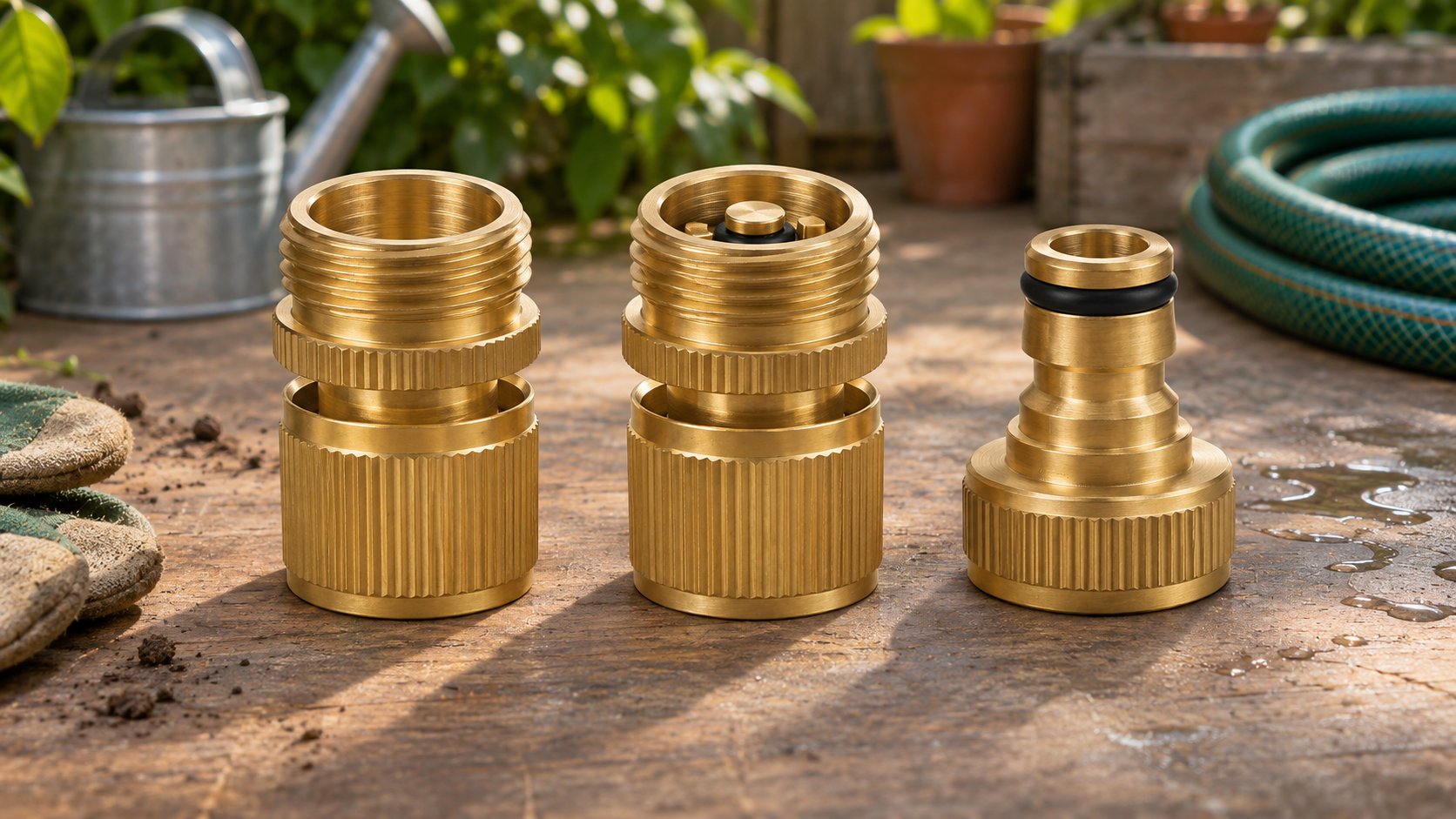
Identify the plug, socket and hose connection
A quick-connect pair has a plug on one side and a receiving socket or coupling on the other. The socket’s retaining mechanism engages the plug, while a seal limits leakage around the joined parts. On a hose-end product, another connection secures the socket to the hose. That may be a threaded coupling, clamp or compression-style arrangement depending on the design. The thread or hose size describes this second interface, not necessarily the mating profile of the quick-connect pair.
Before comparing water-stop functions, draw the complete chain: outdoor tap, hose, socket, plug and attached nozzle or sprinkler. Mark which part stays on the hose when a tool is removed. Product photographs often show a brass plug and socket side by side without making clear which one carries the shutoff valve. Ask for a sectional drawing or a sample to identify the valve and seal locations.
Do not assume that two items sold as “quick connectors” can be paired. Plug dimensions, locking geometry and O-ring positions vary by system. A pair can feel as if it snaps together yet fail to seal or release correctly. Confirm both model numbers and the supplier’s compatibility statement for the exact pair. If a distributor wants a mixed-brand kit, validate the combination physically and document it rather than making a universal claim.
What changes when the accessory is disconnected?
In an open-flow design, removing the plug leaves an open route from the pressurized hose to the socket outlet. The user normally closes the tap or another upstream valve before disconnecting, or water can discharge. In a water-stop design, the released plug allows an internal valve in the hose-end socket to close. Reconnecting a compatible plug opens the path again. GARDENA describes this behavior for one of its water-stop connector models; the exact action should be confirmed for the model being sourced.
| Condition | Open-flow socket | Water-stop socket |
|---|---|---|
| Compatible plug fully engaged | Water can flow through the joined path | Plug opens the internal stop valve; water can flow |
| Plug released while source is on | Outlet remains open and water can discharge | Internal valve is intended to close the hose-end outlet |
| Source turned off and pressure relieved | Safe condition for planned service or inspection | Still the appropriate condition for service or seal replacement |
| Wrong plug or incomplete engagement | Seal and retention are uncertain | Valve may fail to open fully or the joint may leak |
A water-stop feature is a convenience for changing tools. It is not a substitute for shutting off the water source before disassembly, maintenance or leaving a system unattended. The socket and hose remain under upstream pressure when the stop valve is closed. Packaging should make that distinction clear, especially if the product is sold with a timer or irrigation accessory.
Where the stop valve can affect flow
The internal valve, spring and passages occupy space inside a water-stop socket. That geometry can create a narrower effective path than a different open-flow design. The actual pressure drop depends on the model, the flow and the rest of the system; it should be measured rather than inferred from the label. A premium or “maxi-flow” name is not a numerical performance specification. Even products from one brand can have different connector profiles and intended hose sizes.
For a flow comparison, assemble each connector with the same hose, mating plug and downstream tool. Use the same supply condition and measure flow at the same point. State whether the nozzle or sprinkler is attached and fully open. Compare pressure before and after the connector at a specified flow if the buyer needs a pressure-loss claim. Do not compare an open socket with no tool to a water-stop socket attached to a restrictive nozzle; that tests different systems.
If a sprinkler performs poorly, the connector is only one possible restriction. Check the tap, hose bore and length, filter, timer, nozzle and any additional adapters. A quick connector cannot increase the source’s supply pressure. Selecting a less restrictive pair may help a particular assembly, but a claim about percentage improvement requires a repeatable test.
Choose for frequent tool changes or continuous irrigation
A water-stop socket is useful when a user regularly switches between a spray gun, wand and other tools at the hose end. Its automatic shutoff reduces the need to return to the tap for each change. The mechanism should be easy to release with wet hands, seat the plug positively and close reliably when disconnected. Ask for operating-force and cycle-test information if the product will be used frequently.
For a continuously connected sprinkler or irrigation line, the disconnection convenience may be less valuable than flow path, serviceability and compatibility with the chosen components. An open-flow connector may be appropriate if the system already has a planned shutoff and the user does not change tools under pressure. A water-stop connector can still be used, but check its pressure drop and whether its internal valve opens fully with the selected plug.
For equipment OEMs, consider the user’s maintenance sequence. If a connector will be buried under a machine guard or mounted in an inaccessible place, the release mechanism and leak visibility matter. If a hose is pulled repeatedly, review strain relief at the hose connection separately from the plug/socket lock. A strong lock does not prevent the hose from slipping off an incorrectly sized barb or clamp.
Specify both ends of a wholesale set
Record the destination market, hose inner and outer dimensions, tap or tool threads, mating plug profile, socket profile and seal material. Ask the supplier which exact plug variants open the water-stop valve completely. A nominal hose size does not describe the plug geometry. Require the bill of materials to distinguish a standard open-flow socket from a water-stop socket; a similar outer sleeve can conceal a different internal part.
Build an approved sample set with the actual hose and accessory. Check insertion, positive locking, release, flow with the plug connected and leakage with the plug disconnected. Observe whether the valve shuts after repeated cycles. If several colors, finishes or materials are offered, confirm that all variants use the approved internal geometry. A catalog photograph should not be treated as proof that two revisions are interchangeable.
إن Hengxin connectors and fittings category is a starting point for candidate parts. Request model-specific drawings and samples before promising cross-brand fit or “full flow.” Include installation instructions that identify the compatible plug and explain what the water-stop feature does when the tool is removed.
Test records worth retaining
For leakage, note the inlet pressure, test duration, connector state, plug model, water temperature if relevant and the inspection point. Test both the connected joint and, for a water-stop socket, the disconnected state. A drip from the threaded tap adapter is different from seepage at the quick-connect O-ring or water-stop valve. Record the first wet point so the supplier can act on it.
For insertion and removal cycles, document the number of cycles, method, applied force if measured, mating parts and pass/fail condition. Check function at intervals rather than only at the end. Retain the exact samples and revision. If the user-facing package claims a lifetime cycle count, the test method and acceptance criteria must support it; do not transfer a number from another model.
For flow, retain raw measurements and the complete setup. A single flow figure without hose length, supply pressure and accessory state is easy to misread. A buyer comparing suppliers should request tests under the same conditions or arrange a common independent test.
Store images of the plug and socket beside the report. This prevents a later substitution of a visually similar fitting from inheriting an unsupported compatibility or leak claim.
Questions buyers ask
Does a water-stop connector stop flow when disconnected?
That is the intended function of a compatible water-stop socket: its internal valve closes when the plug or accessory is released. Confirm the exact model and test its disconnected leakage. The hose upstream can remain pressurized.
Can I use a plug from another brand?
Do not assume compatibility. Confirm the plug profile, lock and seal against the socket maker’s guidance, then test the actual pair if a mixed-brand assembly is proposed.
Is a water-stop connector always more restrictive?
Its internal valve can affect the passage, but the difference varies by design. Compare pressure drop and flow under the same test conditions rather than relying on the feature name.
Send the intended hose, nozzle or equipment models, target market, expected change frequency and order quantity through Hengxin’s contact page. Ask for paired connector drawings, samples and model-specific leak and cycle-test records.