
A garden hose splitter can provide separate connection points for a drip-irrigation branch and an ordinary garden hose. It does not make the two branches hydraulically independent, and it does not replace the filter, pressure control or backflow protection that a particular drip system or local rule may require. The practical design is to identify the order of parts on each branch, check the available water supply when both are used, and test the complete assembly before selling it as a kit.
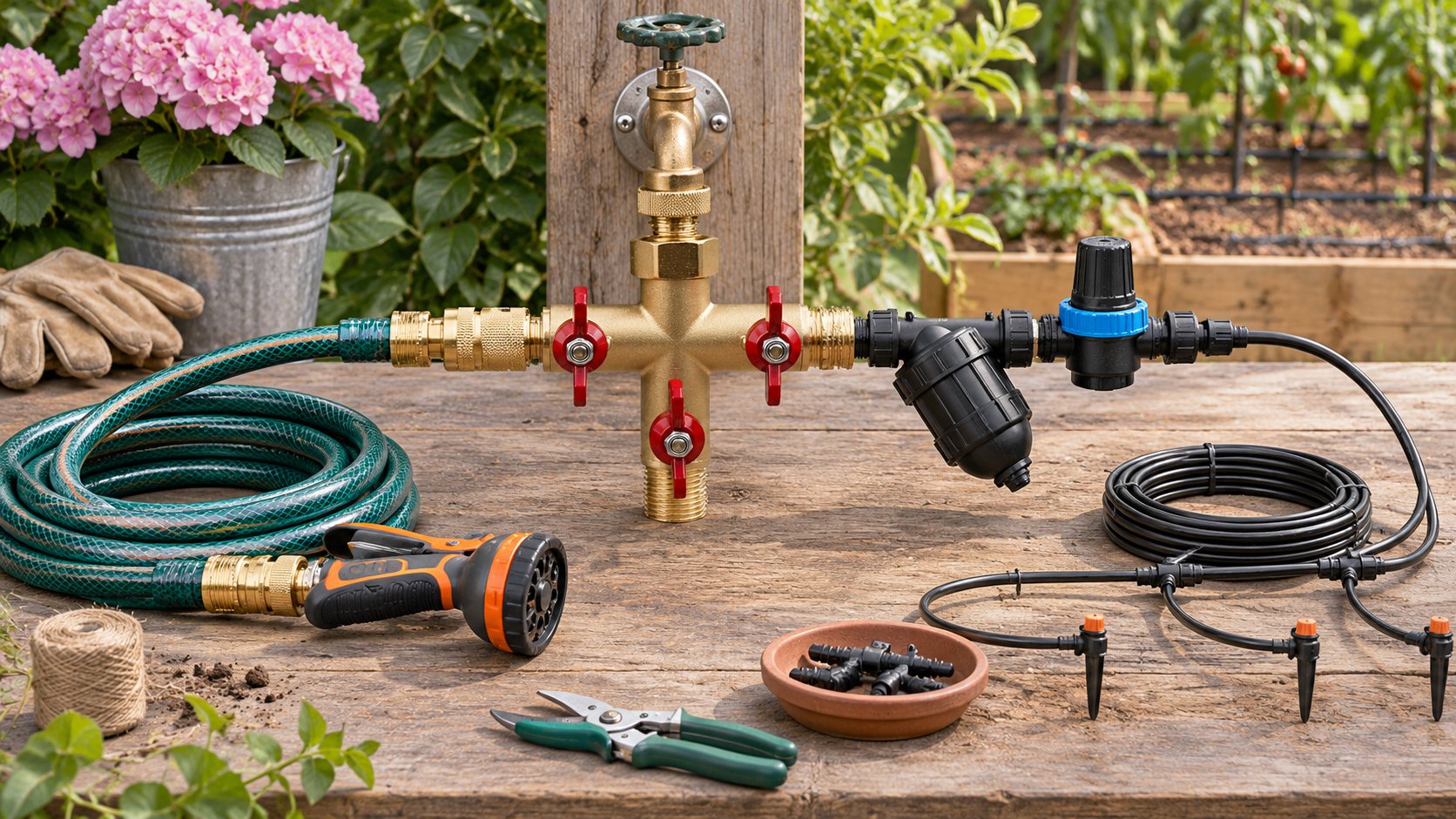
Draw the two branches before choosing fittings
Start at the water source and write a simple connection path. The tap connects to a suitable splitter. One outlet connects to the ordinary hose and its nozzle or sprinkler. The other connects to the drip-system components specified by the irrigation designer, which may include backflow protection, filtration, pressure regulation, adapters, tubing and emitters. Their exact order and type should follow the component manufacturers’ instructions and applicable local requirements.
This drawing prevents a common ordering error: treating the splitter as if it were a complete drip kit. A splitter provides branches and possibly individual shutoff controls. It does not filter sediment, regulate pressure to an emitter’s requirement or prevent reverse flow merely because the outlets are separate. The buyer must identify the missing system components rather than asking for a generic “drip splitter.”
Record the thread and seal at every step. A garden hose connection, pipe fitting and small tubing barb can have similar nominal labels but different joining methods. A drawing of the proposed assembly is more useful than a list of product names. If adapters are needed, name the exact connection on both ends and confirm that the mating seals fit.
Why the drip branch needs its own component review
Drip emitters and small tubing can be affected by debris and by operating pressure outside the range intended for them. The filter and pressure-control components should be selected from the actual drip-system specification, not from the garden hose side of the split. Some systems incorporate these functions in an assembly; others require separate parts. Do not assume that an ordinary splitter valve can substitute for a pressure regulator: partially closing a valve changes resistance but does not hold a constant downstream pressure as demand and supply change.
Backflow protection is a separate question. Water in a hose or irrigation system can be exposed to soil, fertilizer or other contaminants. The required device and installation position depend on the water supply, local rules and the connected equipment. A splitter’s individual valves are not automatically an approved backflow-prevention device. A buyer preparing a kit for several markets should request the relevant local plumbing or irrigation requirements before writing a universal installation instruction.
For the drip side, note the tubing size, emitter type, number of emitters, line length and expected flow. These details influence the choice of filter, regulator and adapter. Hengxin’s splitter range can supply a branching component where the chosen model fits, but the availability of every downstream drip part must be confirmed separately.
Consider simultaneous operation
The two branches draw from the same upstream tap. If a user opens the garden hose while drip irrigation is running, the total demand can change the pressure and flow available to each. The effect depends on the supply, hose, splitter and equipment, so it cannot be reduced to a single universal percentage. A test with only the drip branch open does not prove how the system will perform when someone uses the hose at the same time.
Ask the buyer whether simultaneous operation is part of the intended use. If it is, measure the available supply and test both branches together under a representative condition. Observe the drip system at the point where its manufacturer specifies operating conditions, and check the output of the ordinary hose or nozzle. If the supply cannot support both, scheduling the branches at different times may be more appropriate than choosing a splitter with a larger-looking body.
Separate scheduling has operational implications. A manual splitter relies on a person to choose which valve is open. A timer may automate one branch, but its own passage, orientation and power access need checking. Do not promise that a timer will fit a splitter until the physical assembly has been measured and sampled.
Check the water source and full assembly
Begin with the pressure and flow available at the tap while water is being drawn, not only a static gauge reading with every outlet closed. Build the proposed assembly with the actual hose, drip components and adapters. Record the connection standards and which splitter valves are open. Check for leakage at each joint, and measure or observe performance at the appropriate downstream points.
| Check | Question it answers |
|---|---|
| Tap and splitter inlet match | Will the assembly seal at the source? |
| Separate drip filter and pressure-control specification | Are the emitter manufacturer’s requirements addressed? |
| Backflow protection review | Does the setup meet the water-source and local installation requirements? |
| Both branches open | Can the supply serve the expected simultaneous demand? |
| Hose and tubing connections | Are every thread, barb and seal correctly paired? |
| Installed clearance and support | Can users reach valves without loading the tap excessively? |
Keep the result tied to the exact configuration tested. A change in hose length, emitter count or timer can alter the demand. If the buyer wants to claim compatibility or a particular drip performance, obtain a defined test method and the component specifications that support it. A photograph of water reaching two branches is useful for assembly review but is not a pressure or uniformity test.
Specify a kit without promising components you do not supply
A distributor can offer a splitter as part of a broader irrigation kit, but the bill of materials should distinguish parts from each supplier. List the splitter model and its connection details separately from the drip filter, regulator, tubing, emitters, hose and any backflow device. This prevents an inquiry for a splitter from being interpreted as an order for a complete system.
Packaging should show the actual parts included, the intended connection standards and the installation limits. If a backflow device or pressure regulator is required but sold separately, that condition must be clear in the instructions. Avoid claims such as “works with all drip systems” or “no pressure loss” unless the specific combination has been verified. The product page and packaging should not imply that a brass finish establishes suitability for drinking-water contact.
For private-label projects, approve a sample assembly and keep its drawings, component list and any test records together. Review any substitution of a timer, filter or tubing size before production. A small change at one connection can invalidate an apparently compatible kit.
A field check for the drip branch
Build the drip branch in the order specified by the chosen irrigation components, then check each connection while the ordinary hose branch is closed. Confirm that the filter can be opened for maintenance without disturbing the splitter’s tap connection. Check whether the pressure-control device is installed in the location required by its manufacturer. A regulator selected by appearance or thread size alone may not suit the operating range or flow of the emitter layout.
Next, open the hose branch in the way the end user expects to use it. Observe whether the drip branch still meets the irrigation designer’s requirements. A change in visible emitter output is a reason to measure and review the setup, not a basis for guessing a percentage pressure loss. Record the source condition, valve positions, hose length, connected nozzle or sprinkler and the portion of the drip system operating. If the source is limited, staggered operation may be a legitimate design choice, but instructions should make the sequence clear.
Finally, turn both branches off and inspect every joint for seepage. Recheck after the assembly has been handled during ordinary hose use. The free hose can pull on a rigid tap-mounted kit, so the layout should avoid unnecessary strain. A successful first water test does not replace a review of the installation instructions and local water-system requirements.
What to put in the customer instructions
Show a diagram of the exact kit and identify the drip and hose branches by function. State which components are included and which are supplied by the installer. The instructions should tell users where to find the drip component maker’s operating range and what to do before disconnecting a pressurized fitting. If the kit allows both branches to be opened, explain that combined operation depends on the available supply and the downstream equipment, not simply on the splitter outlet count.
Include the maintenance path for a filter and the location of any separate backflow device or pressure-control component. The wording should reflect the approved assembly rather than generic advice copied from another irrigation kit. For support teams, retain the approved sample and the parts list so that a reported leak or weak drip output can be traced to a specific connection and operating state.
Questions buyers should settle before ordering
Can the hose and drip branches run at the same time?
They can be opened together on a suitable splitter, but the water source must meet the combined demand. Test the complete assembly with both branches operating before promising performance.
Does the splitter regulate pressure for drip emitters?
No. A splitter divides the connection and may provide branch shutoff. The drip system’s pressure-control requirement must be addressed by components specified for that system.
Does a splitter provide backflow protection?
Do not assume it does. The applicable backflow device and installation depend on the source, connected equipment and local requirements. Review them separately.
For a bulk project, send the target market, tap and hose standards, drip component list, planned emitter count, simultaneous-use requirement and expected quantity to Hengxin’s team. Ask for a splitter drawing and a sample configuration while the drip designer confirms the downstream system requirements.