
A garden hose splitter and two water timers can share one tap only when the complete assembly fits and the tap can carry the installed load. Matching thread labels are a starting point, not a fit test. Timer housings, battery doors, screens and control knobs often extend beyond their threaded connection. A buyer planning a bundled assortment should draw the tap, splitter and both timers at their actual dimensions before selecting a two-way or four-way layout.
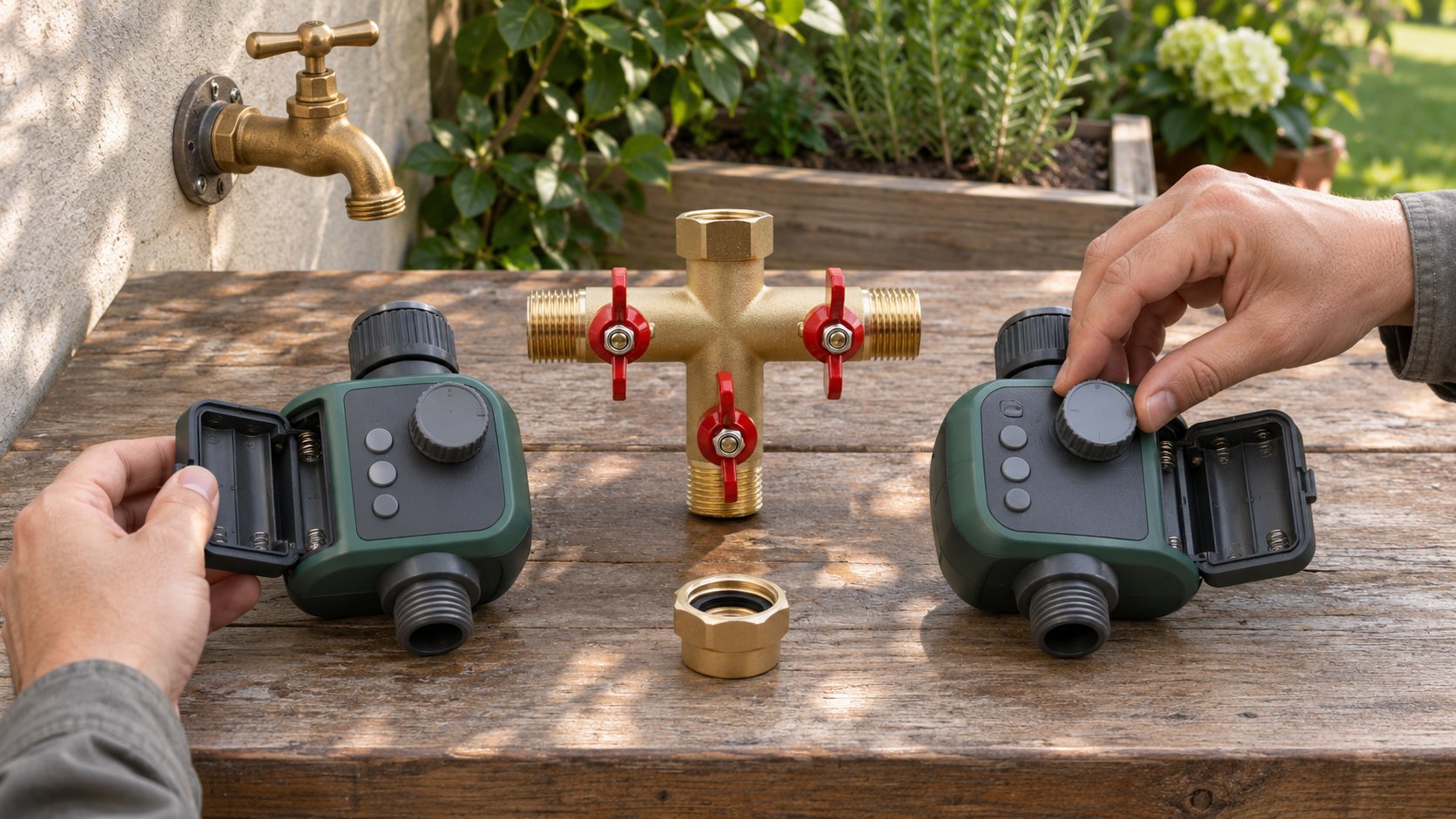
Measure the installation envelope, not just the threads
The installation envelope is the space occupied by every component after it has been attached and operated. Begin at the tap: record the distance to a wall, fence, tank or neighboring outlet. Add the splitter’s inlet projection, overall width, branch angle and outlet spacing from its drawing. Then add the largest width and depth of each timer. If the timer has a removable battery tray, lid or programming dial, include the space needed to open or turn it.
Two timer inlets may screw onto a splitter yet leave no room to finish tightening the second. Another assembly may fit while empty but become difficult to program once hoses are attached. The correct check is performed with both timers, their downstream hoses and any quick connectors in place. A front photograph is insufficient because the tap-to-wall distance and the depth of the timer bodies matter too.
Build a simple dimensioned sketch with three views: front, side and top. Mark the centerline of the tap, the center-to-center spacing of the splitter outlets, the width of each timer at its broadest point and the operating movement of the splitter valves. If dimensions are missing, request a drawing or physical sample. Do not fill an RFQ with values measured from a scaled product photograph.
Compare straight and angled outlets
A straight two-way splitter places branches in one arrangement; an angled or differently oriented design changes the space available around the timers. Neither layout is inherently compatible with every timer. An angled branch can move one timer away from the other, but it may move the housing closer to a wall or make the attached hose bend sharply. A swivel inlet may help orient the assembly on some models, but its presence and movement range must be confirmed for the exact SKU.
Ask whether the timers may be mounted in the planned orientation. Their own manufacturer instructions may constrain the angle or exposure of the battery compartment. Even if the splitter allows rotation, the timer may not. The combined assembly should be tested in the orientation a customer will actually use, with the water supply and downstream hoses connected.
Valve access is another frequent surprise. A red or metal handle that is easy to reach on an empty splitter can end up behind a timer body. Trace each handle’s full operating arc on the drawing. The user should be able to isolate a branch without removing the timer or forcing the handle against a housing.
Account for weight and leverage at the tap
A timer is more than a threaded fitting: its mass is carried some distance from the tap. Two timers, hoses and wet fittings create leverage on the splitter inlet and tap connection. Whether a particular installation needs support depends on the tap, wall mounting, splitter geometry and connected accessories. A catalog description of the splitter cannot certify the strength of every tap.
During sample evaluation, attach the actual timers and hoses and observe whether the assembly sags, twists or places a joint under visible stress. Do not use the hose itself as a structural support. Where the installation is heavy, ask the system designer or installer to specify an appropriate support arrangement. The product instructions should not promise “fits any tap” or “no support needed” without evidence for the intended assembly.
Weight also affects shipping and packaging. If a distributor plans to sell a ready-made kit, the carton should protect the splitter threads and the timers’ vulnerable housings separately. The installed arrangement pictured on the package must match the parts included and their connection standards.
Verify the complete water path
A splitter can divide the available water between two timers, but it does not add supply pressure. Each timer adds its own internal passage and valve. If both schedules overlap, total demand may exceed what the tap and hoses can deliver to the downstream devices. The buyer should decide whether the two branches are expected to run at the same time and test that condition.
Start with the water source and check the pressure and flow available at the tap under operating conditions. Fit the splitter, timers and representative hoses. Record the timer settings and which branches are open. Measure the water delivered at a defined downstream point rather than relying on a single upstream pressure reading. If the application feeds sprinklers or drip equipment, compare the result with the requirements of those downstream components.
A “full-flow” splitter description cannot settle the question. Even a wide splitter passage may be followed by a narrow timer or hose. Conversely, a small reported pressure drop through one component may not represent the whole installed system. Keep the test setup, model numbers and operating state with any measured result.
A compatibility worksheet for wholesale kits
| Item to record | Why it is needed |
|---|---|
| Tap thread, sealing face and wall clearance | Checks the upstream fit and installation space |
| Splitter part number, inlet, outlet spacing and branch angle | Identifies the exact layout being quoted |
| Timer brand, model, housing width and service-door clearance | Checks physical fit and user access |
| Hose connector and downstream equipment | Completes the flow path and installed load |
| One-branch or overlapping schedules | Defines the operating state to test |
| Support method, if required | Prevents the tap connection from being treated as a universal bracket |
Fill the worksheet with drawing dimensions where available, then build one physical sample of the proposed kit. Photograph the assembly from three directions. Check that timers can be installed, removed, programmed and serviced without taking apart the whole setup. Observe every valve position and look for leaks after the full assembly is attached. This practical trial catches issues that separate product photographs cannot show.
Retain the approved timer and splitter revisions with the kit bill of materials. A timer housing can change while its threaded inlet stays the same. If a supplier substitutes a different splitter handle or branch geometry, repeat the fit test rather than assuming the earlier approval still applies.
What a buyer should request from each supplier
For the splitter, ask for a current drawing showing inlet and outlet connections, overall dimensions, branch spacing, handle movement and any swivel function. For the timers, obtain dimensions that include battery access and the maker’s mounting guidance. For both, identify the intended thread system and sealing method. Nominal size alone is not enough to establish compatibility across markets.
Ask for sample terms and a model-specific test plan before ordering a mixed kit. A sales photograph should not be used as proof that two large timers will fit, and a successful fit with one timer model should not become a blanket compatibility claim. Keep the claim narrow: name the tested components and the assembly configuration.
إن Hengxin splitter category shows available layout types, while the swivel-inlet comparison addresses one adjacent design choice. This article is about the timer assembly’s physical envelope and operating access, not a general ranking of splitter designs.
Photograph the installed assembly before approving packaging
Take a front view that shows both timer housings and their distance from one another, a side view that shows the distance from the wall, and a view from below that shows the hose connections. Include a ruler or another scale reference, but keep the timer and splitter model numbers in the inspection record rather than relying on the photograph alone. A close-up of a threaded connection cannot show whether the battery compartment opens after both timers are installed.
Repeat the check with a hose attached to every outlet that the customer will use. A loose timer on a tabletop may fit, while a mounted timer with a stiff hose may rotate or press against the wall. Check whether the valve handles can still move through their intended travel without forcing a timer housing. This is particularly useful when a private-label kit combines components that were designed separately.
Mark the approved orientation on the kit drawing and keep an assembly photograph with the sample. If the installer must rotate a timer to a particular angle, confirm that the timer manufacturer permits that orientation. When the kit is marketed across several countries, document the tap thread and seal for each market; a visually similar adapter can change the installed height and clearance. These records make the compatibility claim reproducible for a distributor and its service team.
Common fit questions
Can any two garden timers sit side by side on a two-way splitter?
No. Check the actual timer housings, outlet center spacing, branch angle and access for controls and battery doors. Thread compatibility does not prove physical clearance.
Will a swivel inlet solve a clearance problem?
It may allow a different orientation on a model that offers the feature, but it cannot change the timer width or every wall clearance. Confirm the swivel range and test the assembled parts.
Do overlapping timer schedules affect flow?
They can. Two active branches draw from the same source. Test the complete setup with both timers open and compare downstream performance with the equipment’s requirements.
For an OEM or distribution kit, send the tap and timer drawings, installation space, target market, planned schedule, connected hoses and expected quantity to Hengxin’s team. Ask for the splitter drawing and sample configuration that can be checked against those inputs.