
Brass and aluminum hose fittings can become difficult to separate after outdoor use, especially when moisture remains around their metal-to-metal joint. Galvanic corrosion is one possible contributor; damaged threads, deposits and overtightening can produce a similar complaint. A seized fitting is a symptom, not a diagnosis. Identify both materials and inspect the joint before writing a material rule for every installation.
Why the metal pairing deserves attention
When dissimilar metals touch electrically and an electrolyte such as water bridges them, galvanic corrosion can accelerate attack on the less noble metal. The City of San Diego’s water facility design guidance identifies aluminum as susceptible when coupled to copper alloys in water service. NASA’s corrosion overview also describes the role of dissimilar-metal contact. These sources explain a mechanism; they do not predict the service life of a particular garden fitting.
The joint is exposed to more than metal choice. Water chemistry, wet-dry cycles, trapped soil, coating condition and the relative exposed areas can all change what happens. A pair that separates easily in a dry sample check may become difficult after months outdoors. Conversely, a stiff joint on day one may be an installation or thread-form problem rather than corrosion.
Read the evidence at the joint
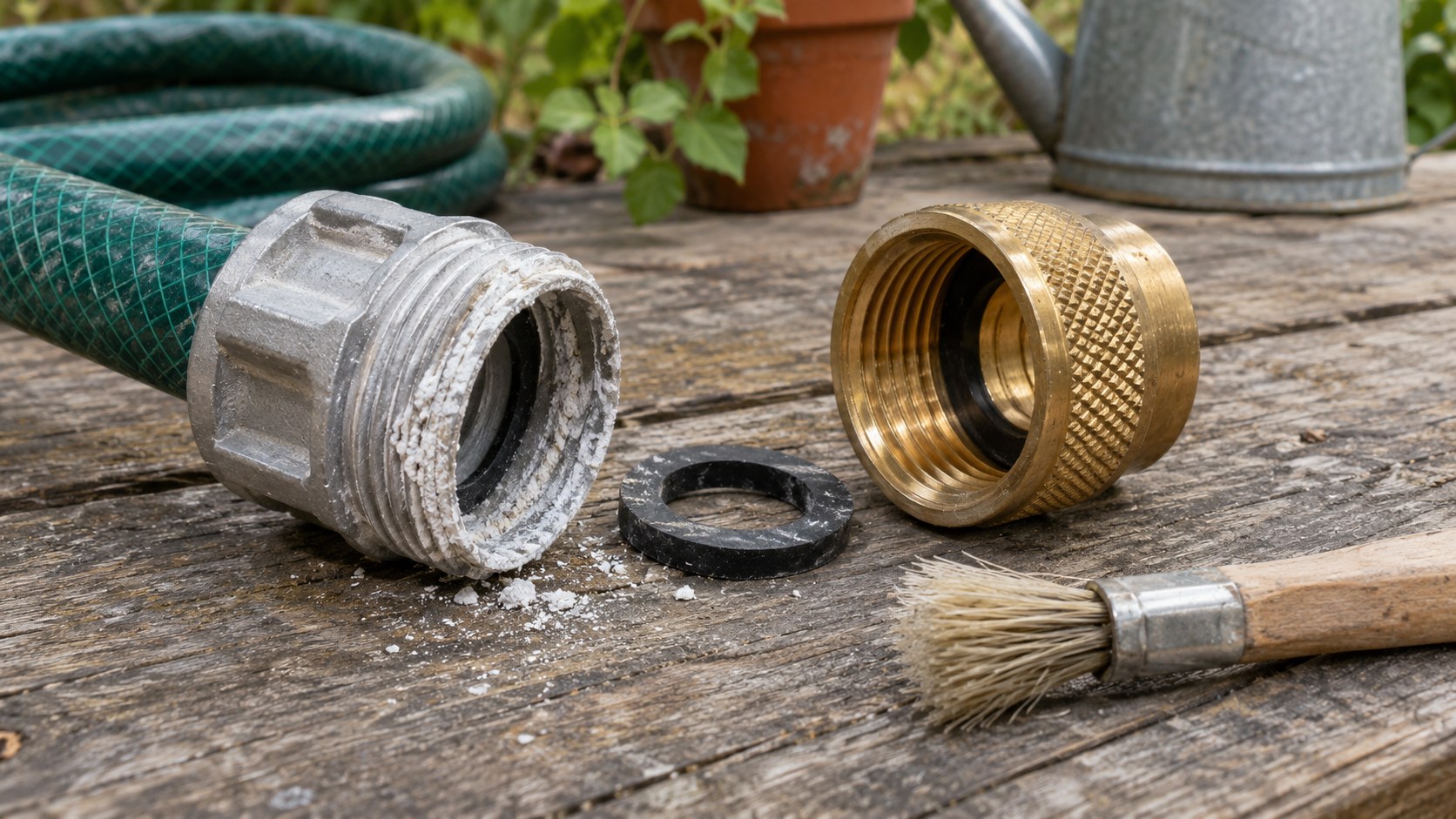
White, powdery material around an aluminum component can be consistent with aluminum corrosion, but appearance alone is not a laboratory identification. Look for damaged thread crests, cross-threading, a crushed washer, sealant residue and mineral deposits as well. Photograph the parts before cleaning them. Record which component stayed on the tap, how long the pair was installed and whether the customer used tools during assembly.
Do not tell a customer to force a seized connection. Excess torque can damage the tap or break a fitting. Isolate the water, support the faucet, and follow the product maker’s removal advice or use a qualified service person when the joint will not release normally. The warranty review should preserve the returned pieces for inspection rather than destroy the evidence during an improvised removal attempt.
Ways to reduce the exposure
For a planned product bundle, matching metal selections or a suitably designed isolating interface may reduce direct dissimilar-metal contact. A nonconductive washer can interrupt one path, but it does not guarantee electrical isolation if metal threads still touch. Some coatings help only while intact. Any claimed isolation method needs a drawing that shows the real contact paths and testing in the intended environment.
Regular removal and inspection may be sensible for seasonal garden accessories. Drain and store removable fittings when the installation instructions call for it. Do not prescribe a universal inspection interval without service data. If lubricant or anti-seize is considered, verify compatibility with the elastomer seals, water application and destination-market requirements. A generic workshop lubricant may be unsuitable for a connector used around drinking-water equipment.
A return-analysis record for buyers
| Record | Why it helps |
|---|---|
| Tap and accessory material, model and coating | Identifies the actual metal pair |
| Thread standard and installation instructions | Separates geometry errors from later corrosion |
| Time installed and water exposure | Gives context for deposit formation |
| Photos before cleaning and after separation | Preserves location and appearance of damage |
| Washer and sealant details | Shows other possible causes of binding or leakage |
| Lot and supplier records | Supports a batch-level review if complaints repeat |
Do not turn one return into a claim that all aluminum or all brass garden fittings fail. Compare several returns with unused controls and, if needed, material verification. Water chemistry and plating deserve attention when a problem appears in one region but not another. Keep a separate category for mechanical damage: cross-threading often leaves a different pattern from gradual corrosion.
Corrosion or mechanical seizure?
Ask when the resistance began. A connection that felt wrong on the first turn points toward a thread mismatch, burr or misalignment. A joint that installed smoothly but became immovable after a wet season deserves an environmental review. These clues are preliminary. The same joint can have more than one cause: a slightly damaged thread can trap water and make later corrosion more likely.
Inspect the washer too. A swollen or displaced seal may make removal feel difficult even when the threads are intact. If metal shavings appear, preserve them and examine the crests. If deposits bridge the joint, note their location and color before washing the parts. A laboratory can identify the material when the claim is consequential; a customer-service photo cannot establish the chemistry on its own.
Plan a comparison before changing materials
If returns suggest a recurring problem, compare the current mixed-metal assembly with a proposed alternative under the same wetting and drying conditions. Keep thread form, washer and installation method constant where possible, so that the material change is the main difference. Record the water used, exposure duration, number of specimens and removal effort. Look for leakage and thread damage as well as surface appearance. A prettier sample that leaks is not an improvement.
Ask whether an aluminum connector has a protective finish and whether that finish survives normal installation. A plated or anodized surface can be scratched at the thread; the coating description alone does not prove a durable barrier. Likewise, a loose plastic spacer may separate visible faces while leaving direct metal contact elsewhere. An isolation claim needs the full assembled cross-section and a test that represents repeated use.
Use careful packaging language
If a kit includes both brass and aluminum parts, name the material of each piece. Give the user the intended assembly order and any approved removal or seasonal-storage instructions. Avoid “corrosion proof” or “never seizes.” Those phrases imply a guarantee across water conditions and usage patterns that a single sample cannot support. If the product is meant for a specific tap material, say which one and keep the supporting test on file.
Distributors should track the mating accessory named in a complaint. A brass hose connector attached to an aluminum tap adapter is a different material pair from the same connector attached to a brass tap. Without the mating part, the returns database may misleadingly attribute every event to one SKU.
Before changing a product line, look at the cost of the alternative as a whole: the material of the new part, any isolation component, assembly instructions and the need for new compatibility checks. A change that solves removal difficulty but makes the joint prone to leakage is a poor trade. Use customer returns to frame the test, then let the matched comparison determine the claim.
Keep the first corrective action reversible where possible. Updating the installation instructions or specifying a compatible mating part may be worth testing before changing the metal casting. If the return analysis points to a manufacturing burr, correct the thread process rather than treating the problem as galvanic corrosion. The failure mode should decide the change, and the changed product should be checked against the same acceptance criteria as the original.
For new sourcing, ask the maker which materials will touch in the assembled product and what storage instructions belong on the package. The Hengxin hose connector category shows available forms, but the individual material stack must be verified by SKU. Send the mating tap or accessory sample with your inquiry if a mixed-metal joint is expected.