
A garden hose nozzle can make a stream look more forceful by concentrating water at a smaller outlet, but it does not generate additional pressure at the water source. The nozzle changes the relationship between flow, pressure loss and exit speed in the hose system. This distinction matters when a product is marketed as a “high pressure hose nozzle”: a stronger-looking jet is not the same as a pump-powered pressure washer. Buyers should ask for the inlet condition, outlet setting and measured result before approving a cleaning or range claim.
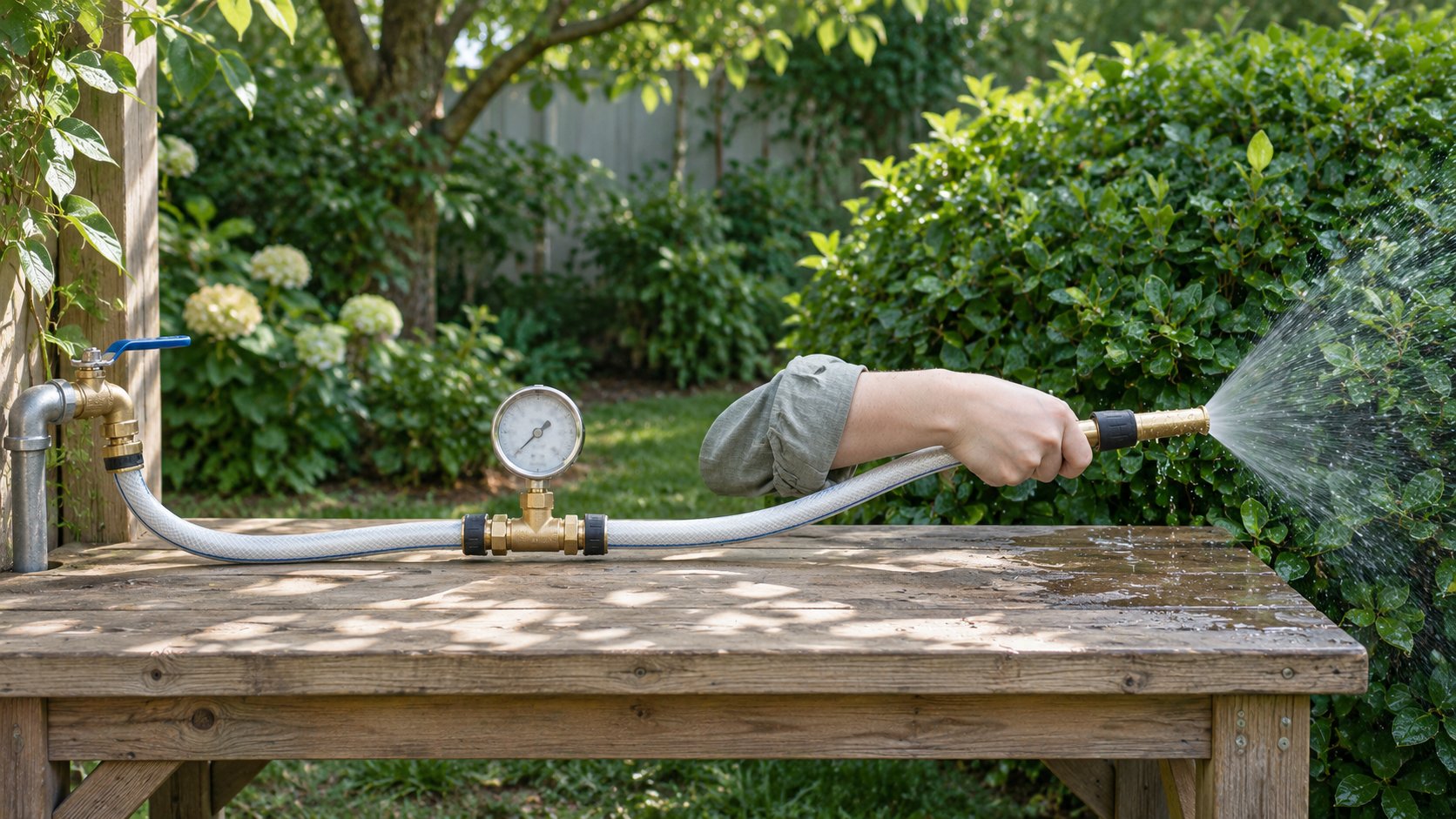
Separate source pressure, operating pressure and exit speed
Source pressure is the water supply condition available at the tap under a defined state. Static pressure is measured when water is not flowing. Operating pressure is measured while a specified amount of water moves through the hose and nozzle. Exit speed describes how fast the water leaves the nozzle opening. Flow rate describes the volume delivered per unit time. These quantities are related but not interchangeable.
A nozzle can turn some pressure energy of moving water into a faster, more concentrated stream at the outlet. The University of Illinois Physics Van explains why narrowing a garden-hose opening can make a stream travel farther even as total flow decreases. The effect depends on the hose and supply; closing the opening too far eventually reduces the flow to zero. A jet’s visual reach alone does not prove a new source pressure.
A pressure gauge immediately upstream of a nozzle can show a higher reading when the nozzle is partly closed than when it is fully open. That is because less flow can mean less loss through the supply hose, and the restriction changes the pressure distribution. It is not evidence that the nozzle has created energy or raised the municipal or pump source’s available pressure. State the gauge location and whether water was flowing whenever publishing a pressure figure.
What a smaller opening actually changes
Imagine the same hose supplied from the same tap. With a wide open outlet, a relatively broad stream leaves at a certain flow and speed. Narrowing the nozzle can increase the stream’s speed and reach over part of the adjustment range while reducing the amount of water delivered. The nozzle also adds resistance, and real losses in the hose and fitting mean the outcome is not captured by a simple “smaller hole equals more pressure” slogan.
| Observation | Possible explanation | What to measure |
|---|---|---|
| Jet reaches farther | More concentrated outlet stream and changed exit speed | Range at a defined angle, flow and inlet condition |
| Bucket fills more slowly | Lower total flow through the restricted opening | Collected volume over a timed interval |
| Gauge near nozzle reads higher | Less flow loss upstream of the restriction | Gauge location and pressure with nozzle open and partly closed |
| Jet becomes weak at extreme closure | Outlet is too restricted to deliver much water | Flow and setting position |
Les Smithsonian explanation of convergent nozzles describes the conversion between pressure and speed in a narrowing passage. Real garden nozzles add friction and spray breakup, so a buyer should use measured performance for a claim rather than treating an ideal equation as a product guarantee.
Why a garden jet nozzle is not a pressure washer
A pressure washer uses a powered pump and components rated for a different operating system. A garden hose nozzle attaches to the available tap or hose supply and reshapes its outlet stream. It cannot turn an ordinary unpumped garden supply into the operating condition of a pressure washer. Marketing that presents a brass jet nozzle as an equivalent tool can create an unrealistic expectation and can also encourage unsafe use on delicate surfaces.
For cleaning tasks, evaluate what the nozzle can do under a representative tap supply: rinsing loose soil from tools, washing a path or reaching a plant bed. State the test surface, distance and duration if a performance claim is made. Do not imply that a visually narrow stream removes embedded dirt or replaces a specialized cleaning machine without a direct and properly defined comparison.
Use the manufacturer’s pressure rating for the exact nozzle, hose and fittings. A component’s rating is a limit or specified operating range, not a promise that the user’s tap will deliver that pressure. Do not connect a garden nozzle to an unapproved pump to make a promotional video. A stronger source requires every component in the assembly to be suitable for the application.
Where pressure is lost before the nozzle
Water travels through the tap, hose, couplings, timer, splitter and any filters before reaching the nozzle. A long or narrow hose and multiple restrictions can reduce the pressure available at the nozzle while flowing. Rain Bird’s nozzle guidance distinguishes pressure at the operating nozzle from pressure at a distant source and notes the effect of small pipe or hose diameter. This is why a tap-side gauge reading cannot alone validate a nozzle range claim.
For a buyer’s test, keep the hose length and bore, fittings and source the same when comparing nozzle designs. Measure near the nozzle inlet under flow if the purpose is to isolate the nozzle. If the purpose is to represent the end user’s complete kit, measure and report the entire kit instead. Both are valid questions, but they produce different numbers.
Do not overlook partially closed valves or a water-stop quick connector that is not fully opened by its plug. A nozzle may be blamed for weak output when an upstream part is the actual limit. Work from the source toward the outlet, checking one component at a time.
Set a reasonable test boundary
Define the nozzle model and revision, inlet pressure and its measurement point, water source, hose specification, attached fittings, nozzle setting and test method. For a flow test, collect a known volume over a measured time or use a calibrated instrument. For jet reach, state the nozzle angle, height, distance method and environmental conditions. Wind can change an apparent spray distance. For cleaning, specify the surface and starting condition.
Test more than one inlet condition if the product will be sold across markets with different supplies, but stay within the manufacturer’s documented rating. A single dramatic video at an unusually favorable source should not become a universal promise. Retain raw results and representative production samples. If the supplier cannot provide those, use descriptive copy that does not invent a numerical increase.
Do not calculate a pressure increase from the outlet diameter alone. The complete system determines flow, and outlet geometry may vary through a twist nozzle’s adjustment range. A visible jet is useful for showing a setting; it is not a pressure gauge.
Write “high pressure” copy with care
The phrase “high pressure hose nozzle” is commonly used to describe a concentrated jet, but it is ambiguous. If a product listing uses it for search relevance, explain what is actually being offered: an adjustable garden nozzle that produces a focused stream from the available hose supply. Avoid claims that it boosts water pressure, multiplies tap pressure or matches a pressure washer unless a defined system test supports the exact statement.
A clearer product description names the connection, adjustment method, intended tasks and rated operating conditions for the actual SKU. If performance data exists, show flow and spray results alongside the inlet conditions. The Hengxin garden hose nozzle range provides candidate models; buyers should request each model’s drawing, sample and test data before approving a quantitative claim.
This approach helps distributors avoid returns from customers who expected a pump-powered cleaning tool. It also gives technically minded buyers a way to compare nozzles on the same basis rather than relying on the most dramatic photograph.
For packaging, place any numerical spray claim beside its test condition. “Reaches 8 m” without source pressure, nozzle angle and wind conditions is difficult to reproduce. If the product is sold with a different hose or quick connector, check the complete kit again. A result measured on a bare nozzle at a test stand does not automatically describe a retail kit with several upstream fittings.
Retain the original measurements with the approved artwork.
Questions about nozzle pressure
Does a smaller nozzle increase supply pressure?
No. It can change the pressure distribution in the hose and make a jet faster or farther over part of its range, while often reducing total flow. It does not create additional pressure at the source.
Is a garden jet nozzle a pressure-washer nozzle?
No. A garden nozzle uses the available hose supply. A pressure washer uses a pump and a system built for its own operating conditions.
Why does the jet look stronger but fill a bucket more slowly?
The opening may concentrate the stream while restricting total volume. Measure flow and reach under the same source and hose conditions to compare settings fairly.
For a wholesale nozzle project, send the target market, hose and fitting setup, expected source conditions, intended cleaning or watering tasks and order volume through Hengxin’s contact page. Request model-specific pressure ratings and repeatable flow or spray tests before publishing performance claims.