
A female-to-female garden hose connector joins two compatible male-ended fittings. The use case differs from a male-to-male joiner: a male tap outlet and male-ended accessory, two equipment ports, or another pair of external-thread parts may need a double-female adapter. Before selecting one, confirm each male thread, both gasket seats and whether either female nut swivels. A part with two female openings can still be wrong if one nut bottoms out before its washer contacts the mating face.
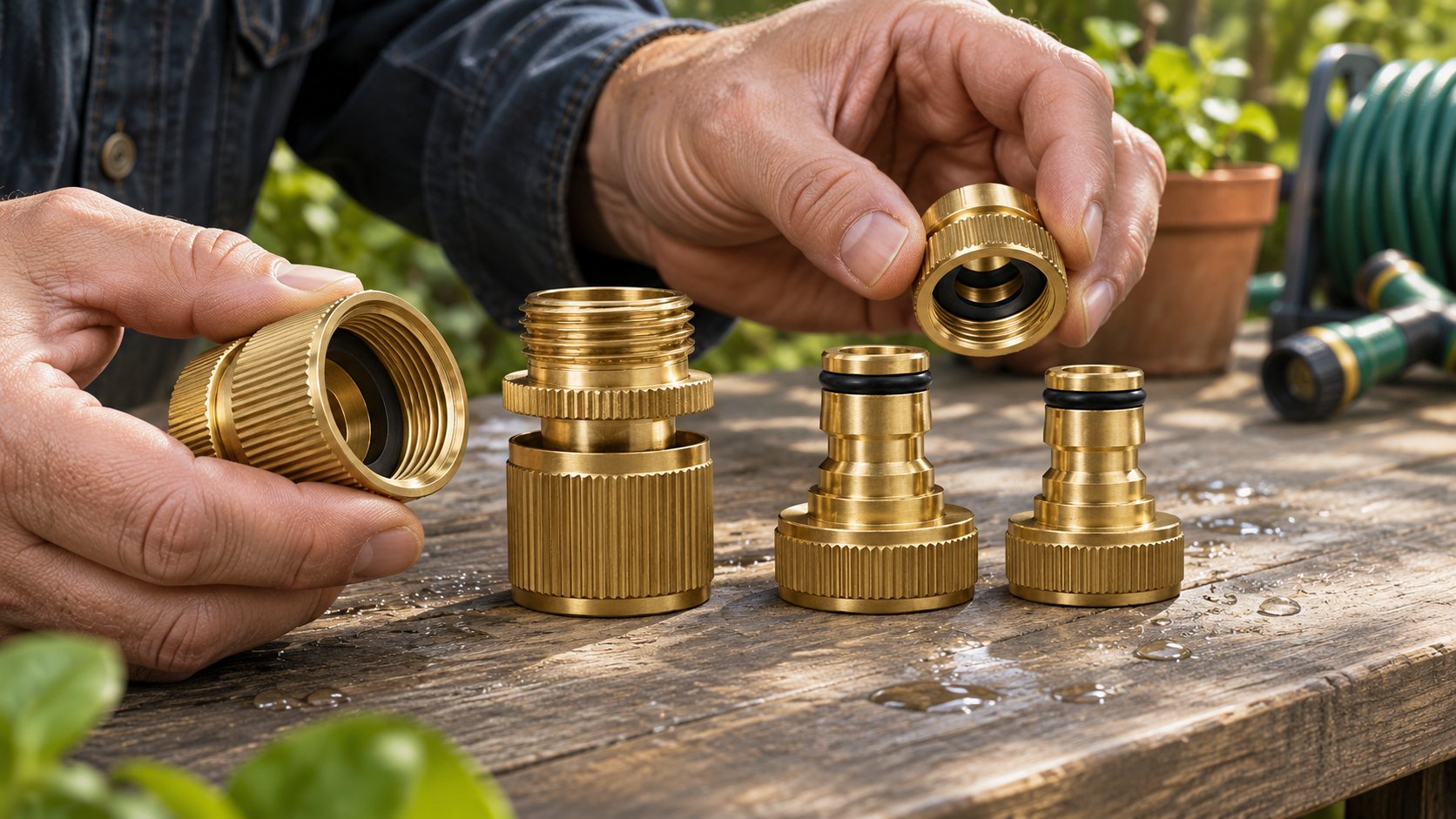
Draw the two male-ended parts first
Sketch the intended route as male part A → female side A of the connector → female side B of the connector → male part B. Identify whether part A is a tap, valve, timer, nozzle adapter or another fitting. Identify part B just as precisely. A generic “double female hose adapter” listing cannot tell a buyer whether both mating male ends use the same garden-hose thread or whether one is a different pipe thread.
The sketch should show the direction of installation. If both male parts are fixed in place, a rigid adapter with two non-swiveling female ends may be impossible to tighten without rotating one whole component. A swiveling nut on one or both sides may allow the connection to be assembled while the bodies stay aligned. Check the specific swivel’s seal and range; the word “swivel” alone does not prove that the adapter can absorb every angular mismatch.
If the assembly is tap-mounted, account for the weight of the attached part and hose. The female-to-female adapter creates another joint and can add length or leverage. It should not be used to force a heavy timer or valve into an unsupported orientation. A sample assembly on the actual tap or fixture will reveal clearance and strain that a catalog drawing cannot show.
Fixed female ends versus swivel nuts
A fixed female thread is integral to the adapter body. The entire adapter must rotate to engage the male thread. This can be simple when one male component is loose on a workbench. It is less convenient when both male components are mounted. A swivel nut rotates relative to the adapter body, letting the installer tighten the nut without turning the body or attached hose. That convenience introduces an internal swivel seal that needs its own inspection and test.
| Conception | Installation benefit | Check before ordering |
|---|---|---|
| Two fixed female threads | Simple body on loose components | Can at least one male component rotate during assembly? |
| One swivel female nut | Allows one end to tighten while body remains positioned | Is the swivel on the end that will be installed last? |
| Two swivel female nuts | Allows both ends to be tightened with fixed equipment | Are both swivel seals and retaining parts serviceable and tested? |
Do not confuse a swivel nut with a flexible coupling. It may rotate for installation but still requires the two mating faces to align. Side loading can disturb a gasket or shorten service life. If the equipment ports are offset, use a layout designed for the offset rather than drawing them together by tightening the nuts.
Check the washer seat on both sides
For a typical garden-hose washer connection, each female side needs a flat washer seated against a surface that can press onto the male end face. Check whether the adapter includes washers on both sides, whether each washer can be removed for service and whether the nut retains it during handling. Do not assume a washer visible on one side also seals the other. Some products use an O-ring or another designed seal; follow the exact drawing.
Inspect the male end faces as well. A sharp burr, deep scratch or uneven rim may prevent the washer from sealing even if the thread fits. The nut should provide enough engagement to compress the washer before it contacts a shoulder on the male part. Measure the relevant recess depth and male thread length when unusual equipment is involved. Do not treat a leak at the swivel joint as a washer leak at the male face; dry the part and identify where water first appears.
Les Hengxin thread-system guide distinguishes garden-hose, NPT, BSP and hose-barb interfaces. That overview is useful for avoiding a wrong family of fitting, while the double-female adapter drawing must define the two actual seal seats.
Use an assembly order that avoids hose twist
Shut off the water and relieve pressure before installation. Check both male parts and washers. Start the first nut by hand, keeping the faces square, and tighten according to the product guidance. Position the adapter body and connected hose without twisting. Then start the second nut by hand. If a swivel nut is provided, use it for the end that must be tightened after the rest of the assembly is positioned.
Do not use the hose as a lever to gain another turn. If a nut will not start cleanly, back it off and recheck the thread form and alignment. Cross-threading can create a joint that feels tight but leaks or damages the mating part. If both ends are fixed and the final connection requires twisting a hose, change the assembly method or select a suitable swivel design. A connector should not be specified solely because it can be forced together once.
After installation, route the hose so it does not pull sideways on the adapter. Open the water slowly and inspect the first joint, second joint and any swivel seam. Check again during representative flow or movement. If water appears, shut off the source, relieve pressure and inspect the specific interface rather than tightening every nut indiscriminately.
Distinguish a serviceable washer from a sealed assembly
A replaceable flat washer can be part of a maintenance kit if the supplier provides its dimensions and material and if the nut design allows replacement. Record which side it serves. A sealed swivel joint may have an internal O-ring that is not intended for field replacement. Do not instruct users to prise apart a crimped or retained swivel without a manufacturer procedure.
For distributor returns, ask whether the leak is at the male face or behind a rotating nut. A washer change may fix the first but not the second. Photograph the first wet point and retain the connected male parts for comparison. If the pressure-containing body is cracked, the nut is stripped or the swivel retainer is damaged, remove the adapter from use and request supplier review.
Replacement-part availability should be verified before packaging says “easy to repair.” A washer with an uncommon section may not be in a retailer’s general assortment. List the actual service part number and the model variants it fits.
Build the wholesale specification
Request a drawing that labels side A and side B thread form and nominal size, washer seat, recess depth, effective thread engagement, nut outside diameter and overall length. If a side swivels, show its rotation and seal. Record material, finish, model revision and approved mating parts. Specify whether the product is sold with one or two washers and how they are retained in transport.
Packaging should show the connection orientation and exact thread systems in the target market. “Female-female” describes gender but not compatibility. If the part transitions between standards or sizes, mark each end clearly on both the bag and the drawing. If both sides are identical, say so only after checking the production item. A private-label instruction should show where users must shut off the water and how to avoid hose twist.
Test a sample with the male parts in the customer’s real assembly. Include a leak check at each face and any swivel joint, plus an installation trial that shows whether the nuts can be tightened by hand in the available space. For a performance or durability claim, obtain a defined test method and representative production samples. The Hengxin fittings category lists candidate products; ask for the exact drawing before approving packaging copy.
Keep an assembly photograph showing the order in which the two nuts were tightened. This matters for customer support: a complaint about hose twist may be caused by the installation sequence rather than the connector’s thread. The photograph should also show whether each male part has a flat sealing face and where any separate support is placed.
Questions buyers ask
Do both female ends need washers?
For a model designed to seal each garden-hose male face with a flat washer, yes, each side needs its own correct seal. Check the model drawing because other sealing designs exist.
Does a swivel nut prevent every hose kink?
No. It can make installation easier and reduce the need to twist the hose while tightening, but hose routing and side load still need attention.
Can I connect a male NPT fitting to one side?
Only if that side is explicitly specified for the NPT form and its intended seal. A garden-hose female thread should not be forced onto a different pipe thread because both are called “male” and “female.”
Send drawings or photos of both male-ended components, the target market, installation space and expected order quantity through Hengxin’s contact page. Request a dimensioned adapter sample with the intended washer and swivel arrangement.