
Garden hose quick connectors may fit across brands, but only a test of named parts can support that claim. A shared tap thread does not make the plug and socket interchangeable. Test complete pairs, including the seal and any water-stop function. Without that record, list the kit’s own matching parts rather than call it universal.
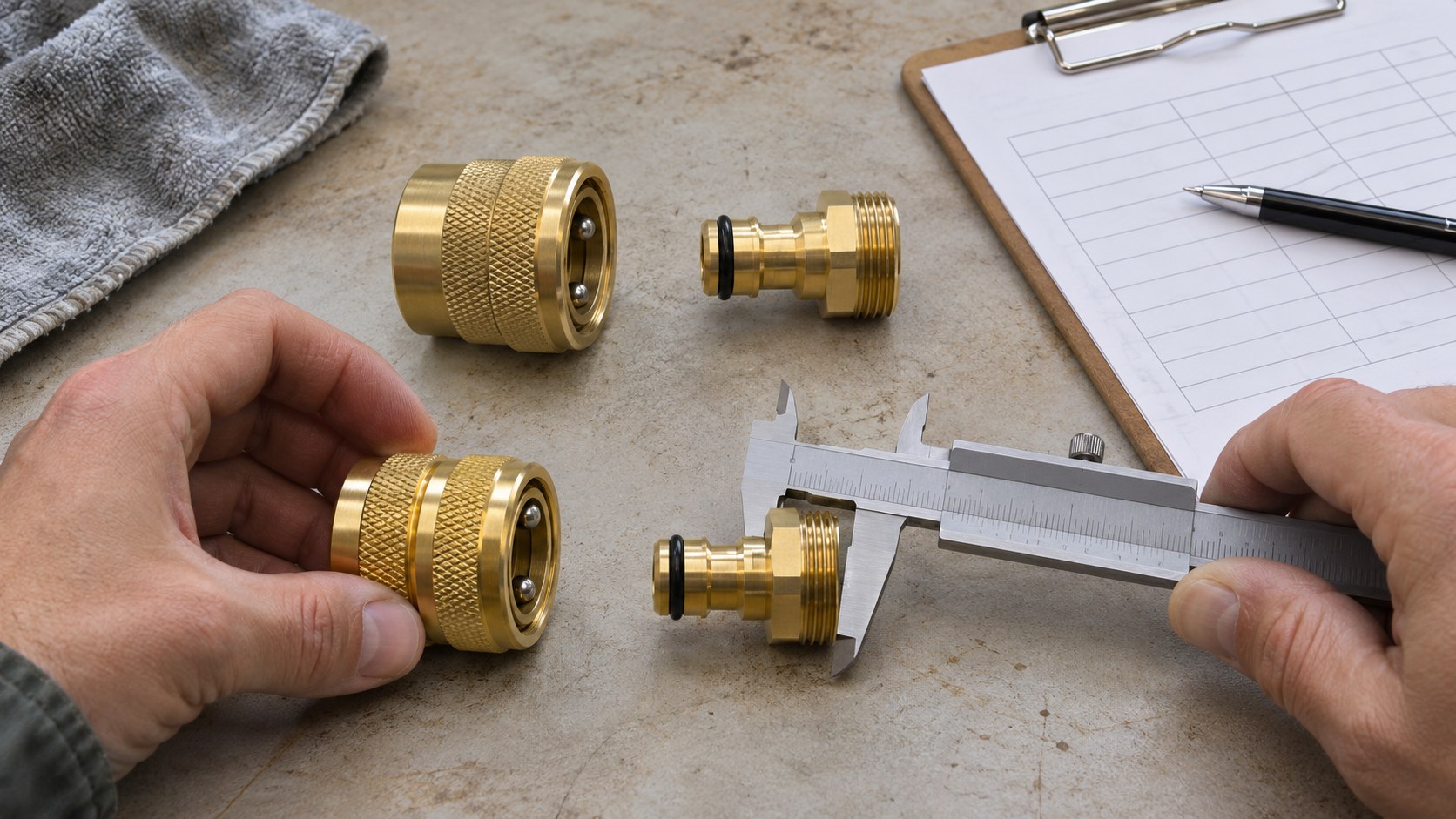
Three interfaces, three chances to mismatch
A quick-connect assembly can have a threaded tap end, a hose attachment and a plug-to-socket interface. The 3/4-inch description often refers to the threaded or hose end. It says little about the plug nose, locking groove or insertion depth. ASME B1.20.7 addresses hose coupling screw threads. It is not a cross-brand standard for every garden quick-connect profile.
The hose end needs its own check too. A socket designed for one hose diameter may be sold in a product family that shares a plug profile with larger or smaller hose versions. A buyer who compares only the front of the connector may overlook a mismatch behind it. Record both the connecting profile and the hose attachment specification in a compatibility table.
Measure the plug before trial assembly
For each candidate pair, identify the plug’s outside diameter at the entry and sealing areas, locking-groove position and width, shoulder location and effective insertion depth. On the socket, check the sleeve travel, retention feature, seal location and internal stop. Dimensional similarity is a screening step; the real pair still needs assembly and water testing.
Keep measurements linked to physical samples. Photograph the plug next to its part label and record the tool used. If a supplier supplies only a marketing image, treat the geometry as unverified. Two catalog photographs can hide a small difference that decides whether the sleeve returns or a water-stop valve opens.
Build a matrix that can survive a revision
A useful cross-brand matrix names both brands, both model numbers, revision or purchase date, the seal used, test conditions and result. Avoid an unqualified green check mark. One pair might connect and hold water while requiring excessive release force. Another might lock correctly but leave the water-stop valve partially closed.
| Pair | Dry fit | Sleeve and retention | Water-stop opening | Leak check | Status |
|---|---|---|---|---|---|
| Named plug + named socket | Record seating depth | Record return and pull check | Check if present | State conditions | Approved, rejected or untested |
| Revised plug + same socket | Repeat after change | Repeat after change | Repeat if present | Repeat | New decision |
“Untested” is a valid status. It tells a distributor exactly where the evidence stops. “Compatible with Brand X” is too broad when that brand sells several connector families or has revised a plug. Name the tested SKU pair on the internal record and use retail wording that matches the scope of the test.
A cross-fit trial in the right order
Start with a dry inspection of both halves. Look for a damaged plug nose, a missing seal or a sleeve that will not travel freely. Next, assemble the pair without forcing it and record seating depth. Release it and reconnect several times to see whether the action is consistent. With the water supply isolated, check retention by hand as the product instructions require. Only then run a water test under the agreed conditions. This order keeps a visibly poor fit from being mistaken for a pressure-related leak.
Repeat the sequence for each direction that matters. Brand A plug in Brand B socket is a different combination from Brand B plug in Brand A socket. A kit with a water-stop socket adds another function to check. If several hose diameters share one quick-connect profile, record the hose-end variant too. A connection may fit at the plug while the hose attachment is wrong for the customer’s hose.
Note the ease of intentional disconnection. A pair that holds water but takes an unreasonable pull on the sleeve is not a good recommendation for frequent tool changes. Record whether the user can reach the sleeve with the hose attached and whether a bulky nozzle touches it. This is especially relevant for retail kits used with gloves or in cramped spaces.
Include the water-stop state
A water-stop socket is meant to interrupt flow when its accessory is removed. A third-party plug must reach the valve actuator as well as lock and seal. It may look fully connected yet leave a narrow opening or fail to open. Test flow in the connected state and closure after disconnection at agreed conditions. Gardena’s water-stop connector description illustrates the intended on/off behavior of its product; it does not validate a pairing with a Hengxin part.
For an open-flow socket, the valve-opening step does not apply, but sealing and retention still do. Keep those two variants separate in the test record. A single “fits” column conceals the reason a combination was rejected.
Language a distributor can defend
Use “designed to pair with the included plug” when that is the only pair tested. Use “tested with [exact model] under [defined conditions]” when a documented cross-brand qualification exists and the other brand’s name may be used appropriately. Avoid “universal fit” unless the scope has been defined and supported across the systems named in the claim. Even a successful sample fit may need requalification if either side changes tooling or sealing parts.
A practical purchasing sequence is to shortlist products from the Hengxin hose connector category, send the mating parts you intend to bundle, and agree on the test sheet before ordering printed packaging. For a quoted kit, include sample IDs, expected hose size and destination market in your inquiry. That gives the supplier a defined pairing to review rather than a brand name alone.
Compatibility record to keep with the SKU
Give the record an owner and a review date. Its columns should be: plug brand and model; plug revision or purchase lot; socket brand and model; socket revision or purchase lot; seal fitted; measured geometry; dry fit; sleeve return; hand retention; water-stop behavior; leakage conditions; disconnect effort; result; and reviewer. Attach photos of the exact parts. Update the row whenever a component or supplier changes.
This record protects against an easy packaging error. A marketing team may reuse an old compatibility claim after the sourcing team changes a plug. If the record is tied to the retail SKU and artwork revision, the claim can be checked before each print run. A failed or untested pair should remain visible in the same file so that a future buyer does not repeat the assumption.
For a trial purchase, request two or more samples of each named pairing from normal production, along with the supplier’s model drawing. If the fit works only after substituting a nonstandard seal, record that configuration as its own kit. Photograph the successful pair from the side so that seating depth is visible. When a buyer reports a mismatch later, the photo and sample IDs can establish whether the returned item is the approved version or a different generation of the connector.
Keep the rejected pair in the file as well. A “does not fit” result should say whether the plug would not enter, the sleeve would not lock, the seal leaked or the water-stop valve stayed closed. That detail prevents the same pair from being retested under a new label without addressing the actual problem.